
D-FantiX Battery Tester
4.5Editor score
No battery required to operate
Simple analog display needle
Affordable price point
This guide compares the top battery testers for household batteries to help you choose the best device for accurate voltage readings and battery health checks.
Finding the right battery tester for household batteries is essential for maintaining your electronic devices efficiently. A reliable tester helps you avoid waste by identifying weak or dead cells before they fail unexpectedly in your remotes or toys.
We evaluated ten top-rated models based on compatibility, accuracy, ease of use, and build quality. Our analysis includes digital and analog options that cover common sizes like AA, AAA, C, D, and 9V to ensure you find the perfect fit.
Each pick highlights unique features such as LCD screens, magnetic tips, or self-powering designs. Remember that product availability and pricing can change frequently, so always verify the latest details before making your final purchase decision today.
4.5Editor score

4.5Editor score

4.6Editor score
This side-by-side comparison outlines the key specifications and capabilities of each tested model to help you make an informed decision for your home electronics needs.

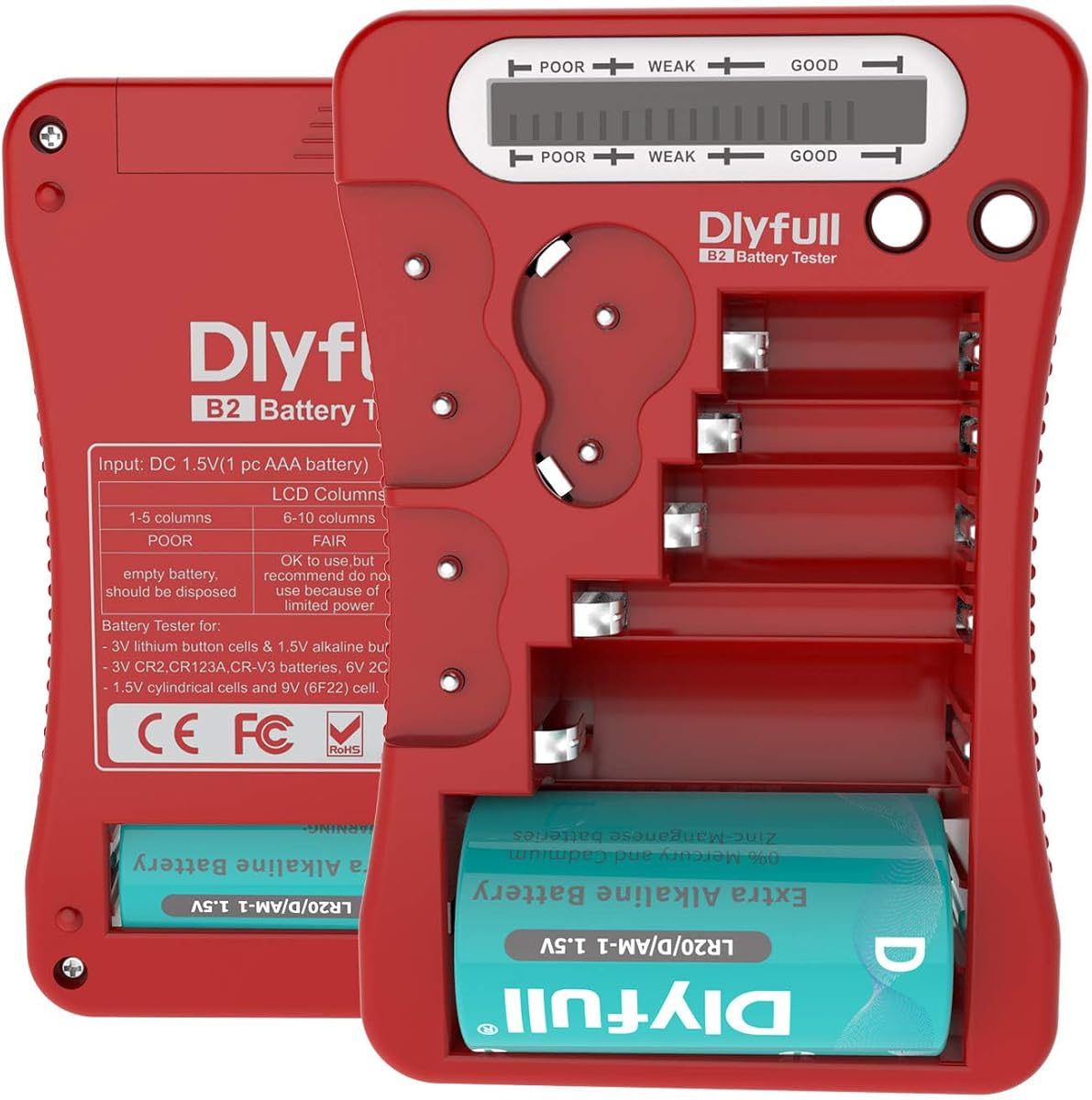


The Dlyfull Battery Tester stands out as a top choice for households needing reliable voltage checks across multiple battery sizes. With a 4.5 star rating it offers a user friendly interface that simplifies the testing process for everyday users.
We may earn a commission when you buy through this link, at no additional cost to you.
Its high compatibility covers AA AAA C D 9V and various button cells making it versatile for toys remotes and flashlights. The crisp LCD screen provides clear health status so you know instantly if a battery is good weak or poor.
While it lacks rechargeable testing capabilities this limitation is acceptable for users focused on standard alkaline cells. The compact lightweight design ensures it can be stored easily in a drawer or tool kit without taking up much space.
We recommend this unit for families who want a straightforward tool to prevent device failures due to dead batteries. Its ability to save money by extending battery life makes it a practical investment for any home.
This tester handles a wide array of cylindrical and button cells ensuring you have one tool for most household needs.
The LCD display uses bars and text to show battery health reducing guesswork and saving time during checks.
We may earn a commission when you buy through this link, at no additional cost to you.
This Universal Battery Checker distinguishes itself by supporting 1.2V rechargeable AA and AAA batteries which many standard testers miss. Its digital design provides exact voltage readings alongside color coded bars for quick status checks.
We may earn a commission when you buy through this link, at no additional cost to you.
The real-load testing feature uses specific resistors to simulate actual usage conditions ensuring more accurate results than simple voltage checks. This engineering prevents false positives where a battery might show voltage but fail under load.
A minor drawback is the need for a separate AAA battery to operate the unit which adds to the initial setup cost. Additionally the screen does not have a backlight making it harder to read in dimly lit environments.
Despite these small issues this model is ideal for tech savvy users who need precise data on battery health. Its sturdy construction and wide compatibility make it a solid choice for workshops or electronics enthusiasts.
Unlike many competitors this tester accurately measures Ni-MH rechargeables ensuring you can reuse them safely and effectively.
Integrated resistors mimic real device usage to give a true picture of battery performance under stress.
We may earn a commission when you buy through this link, at no additional cost to you.
The Dlyfull 1.5V Tester shares similar features with the brand's other models but focuses on speed and portability. It delivers quick results using bars that indicate health status without complex menus or settings.
We may earn a commission when you buy through this link, at no additional cost to you.
Its anti-slip finish ensures a firm grip even when testing smaller button cells which can be tricky to handle. The compact chassis fits easily in pockets allowing you to take it anywhere for on-the-go battery checks.
Users should note that like other Dlyfull units this model does not test rechargeable batteries. This simplifies the design and cost but limits its utility for those using Ni-MH power sources regularly.
With an 18-month warranty included this unit offers reliability and customer support assurance. It is a great pick for households needing a simple durable tool for standard household batteries.
The anti-slip finish prevents drops during testing enhancing safety and ease of use for all ages.
A long warranty period reflects the manufacturer confidence in product durability and quality standards.
We may earn a commission when you buy through this link, at no additional cost to you.
The D-FantiX Battery Tester is an excellent entry-level option for users who want basic functionality without spending much. It operates without an internal battery relying entirely on the battery being tested to move the analog needle.
We may earn a commission when you buy through this link, at no additional cost to you.
Its simplicity makes it very user friendly even for those not comfortable with digital interfaces. The color-coded scale allows you to quickly identify good low or replace status at a glance.
While the analog display may lack the precision of digital voltage numbers it is sufficient for most household needs. The only real trade-off is that reading the needle accurately can sometimes require good lighting.
For families on a budget this tester offers a practical solution to avoid throwing out good batteries. Its small size and low cost make it a no-brainer for general home maintenance.
The unit draws power from the battery under test meaning you never need to replace internal power sources.
At a very low price point it provides essential testing capabilities that save money on unnecessary battery purchases.
We may earn a commission when you buy through this link, at no additional cost to you.
The La Crosse Digital Tester offers a premium experience with its ability to test lithium ion button cells alongside standard alkalines. Its sliding tray mechanism ensures a secure connection for consistent and reliable readings every time.
We may earn a commission when you buy through this link, at no additional cost to you.
Users can select from three voltage ranges to match the battery type ensuring accurate results without manual calculation. The LED display shows both voltage and strength levels making interpretation straightforward for any user.
While it is somewhat larger than pocket-sized testers the robust build quality justifies the size for long-term use. The tray mechanism though convenient might require care to ensure smooth operation after extended periods.
This model is perfect for those who want a versatile tool that handles niche batteries like lithium ion. Its reliability and clear output make it a top choice for demanding household or office environments.
Unique among many testers this unit accurately measures 3V lithium button cells found in watches and key fobs.
The pull-out tray design ensures proper polarity alignment reducing errors during the testing process.
We may earn a commission when you buy through this link, at no additional cost to you.
This 2 Pack Battery Tester offers exceptional value by providing two units in one purchase. It works without any internal power making it a convenient and low-maintenance tool for multiple locations.
We may earn a commission when you buy through this link, at no additional cost to you.
Each tester features clear indicator bars that show the battery level at a glance without needing technical knowledge. The lightweight design allows you to slip one into a drawer and keep the other in your car.
While the design is quite basic it performs the core function of identifying weak batteries effectively. The limitation lies in the lack of digital precision or rechargeable support but this is acceptable for general use.
Buying a two pack ensures you always have a spare available if one gets lost or damaged. It is a smart choice for families with multiple households or shared living spaces.
Receiving two units allows you to distribute them across different rooms or vehicles for maximum convenience.
Since the unit has no internal battery you never have to worry about powering it up or replacing cells.
We may earn a commission when you buy through this link, at no additional cost to you.
The Tenergy T-333 is a robust universal tester capable of handling 12 different battery sizes including specialized types like CR123A. It arrives with an included AAA battery so you can use it right out of the box.
We may earn a commission when you buy through this link, at no additional cost to you.
Its LCD display provides clear health indicators that are easy to interpret. The compact size makes it suitable for travel or keeping in a toolbox for emergency checks when devices fail unexpectedly.
One consideration is that the internal battery for the tester itself is not user replaceable which may limit its lifespan eventually. However given its affordable price it remains a cost-effective option for most consumers.
For those needing a single tool that covers a broad range of standard and specialty batteries this model is highly recommended. Its reliability and ease of use make it a favorite among users.
Beyond standard sizes it handles less common batteries like CR123A which are used in security cameras and tactical lights.
The inclusion of an internal battery means no extra purchases are needed to start testing immediately.
We may earn a commission when you buy through this link, at no additional cost to you.
The Gardner Bender GBT-500A brings a classic analog testing experience with test leads that allow for flexible placement. This makes it easier to test batteries in devices where direct insertion is not possible.
We may earn a commission when you buy through this link, at no additional cost to you.
It supports 14 battery ranges including larger lantern cells which many standard testers cannot handle. The black casing is built to withstand rougher conditions making it suitable for workshop environments.
While the test leads add versatility they can also be seen as a nuisance compared to direct insertion slots. Some users may find the analog scale slightly less intuitive than digital readouts.
This model is a great choice for technicians or older users who prefer analog dials. Its robust construction and wide compatibility ensure it remains useful for years of heavy use.
The included wires allow you to probe batteries inside complex devices without removing them completely.
The sturdy black casing protects the internal components from drops and impacts during work.
We may earn a commission when you buy through this link, at no additional cost to you.
The Dlypow Magnetic Tester uses a built-in magnetic tip to hold batteries in place for stable and accurate readings. This innovative design reduces the hassle of manual alignment during testing.
We may earn a commission when you buy through this link, at no additional cost to you.
Its one-step process makes it incredibly user friendly for quick checks. The large clear display ensures that the battery status is immediately obvious even for those with limited vision.
While the magnet is helpful it might attract dust or metal debris over time requiring occasional cleaning. It also works best on cylindrical shapes where the magnet can find a secure hold.
For those looking for a unique testing method that simplifies the process this unit is a strong contender. Its portability and ease of use make it a great addition to any toolkit.
The magnetic tip keeps the battery steady preventing movement that could lead to false readings.
Designed for simplicity the tester requires just one step to get a clear result on the display.
We may earn a commission when you buy through this link, at no additional cost to you.
The Dlyfull B4 Battery Tester brings modern digital features like percentage-based health displays to the table. This offers a more nuanced view of battery status than simple good or bad indicators.
We may earn a commission when you buy through this link, at no additional cost to you.
A unique self-test button allows you to check the tester's own battery level ensuring it remains reliable before use. The unit supports 12 types including rechargeables and various voltage packs.
While it requires a 1.5V AAA battery to operate it provides detailed data that many simpler models cannot. The slightly lower rating suggests there may be some inconsistencies but the features are robust.
For tech users who want detailed percentage readouts this model is worth considering. Its self-check feature adds an extra layer of reliability to your battery maintenance routine.
Seeing exact percentages helps you decide when to recycle versus keep using a battery for less critical devices.
The dedicated button verifies the tester internal power status preventing false results due to weak internal battery.
We may earn a commission when you buy through this link, at no additional cost to you.
Choosing the right battery tester involves understanding your specific needs regarding battery types and desired accuracy levels. This guide outlines key factors to consider before making your purchase.
Ensure the tester supports all the sizes you commonly use such as AA AAA C D 9V and button cells. Some units may exclude rechargeables or specialized types so check the list carefully before buying.
Look for models that explicitly state support for the battery types you own to avoid frustration later.
Decide between analog needle displays and digital LCD screens based on your preference. Digital screens often provide specific voltage numbers while analog ones offer simple good bad visual cues.
Choose the display style that is easiest for you to read and interpret quickly without confusion.
Some testers require their own internal battery to operate while others draw power from the unit being tested. Self-powered models reduce maintenance but may have limitations in low voltage scenarios.
Consider whether you want the convenience of a self-powered tool or the precision of a battery-driven digital unit.
If you plan to carry the tester in a pocket or travel with it prioritize compact and lightweight designs. Heavier units might be more robust but are less convenient for on-the-go checks.
Select a size that fits comfortably in your storage space or pocket for easy access when needed.
Look for sturdy materials and protective features like anti-slip finishes or durable casing to withstand drops. A well-built tester will last longer and provide consistent results over time.
Invest in a model with a robust build if you plan to use it frequently in varied environments.
Digital testers often provide more precise voltage readings which can be critical for sensitive electronics. Analog testers are simpler but may have slight variations in needle positioning affecting accuracy.
Choose high accuracy if you need exact data for technical applications or general use for everyday checks.
Basic models are often affordable but may lack advanced features like LCD screens or rechargeable support. Higher priced units usually offer better build quality and more precise data for your money.
Weigh the cost against the features you truly need to ensure you get the best value for your budget.
Extra functions like self-test buttons or percentage displays can add convenience and insight to your testing routine. These features help ensure the tool itself is working correctly before you test a battery.
Consider these additions if you want a more advanced experience without paying for a professional-grade tool.
Always ensure the battery is correctly oriented in the tester slots to avoid damaging the device. Check for any visible corrosion on the battery terminals before testing to get accurate results.
Store the tester in a dry and cool place to prevent damage to internal components. Avoid leaving it in direct sunlight or extreme temperatures which can affect the battery life or display.
Clean the contact points periodically with a soft cloth to remove dust or debris that might interfere with readings. This simple maintenance step helps ensure consistent accuracy every time you use the tool.
Some models like the Universal Battery Checker and Dlyfull B4 specifically support 1.2V rechargeable types. Always check the product description to confirm compatibility with Ni-MH or Li-ion batteries before purchasing.
Analog testers typically do not require extra batteries as they draw power from the battery being tested. Digital testers usually need an internal AAA battery which may or may not be included in the package.
Digital testers generally offer higher accuracy with specific voltage readouts compared to analog models. For general household use both types are sufficient to identify dead or weak batteries effectively.
Most universal testers cover AA AAA C D 9V and various button cells like CR2032. Some models also support specialty sizes such as CR123A or 2CR5 so check the list for specifics.
A battery might show voltage under no load but fail under actual device load. Some testers with real-load resistors simulate this condition to give a more realistic health assessment.
It is a to check batteries whenever a device starts underperforming or before storing them for long periods. Regular testing prevents unexpected failures and helps maximize battery lifespan.
The Dlyfull Universal Tester stands out for its balance of compatibility and ease of use making it our top pick. It provides clear health status for a wide range of standard household batteries.
If you need to test rechargeables or want a budget-friendly option consider the Universal Battery Checker or D-FantiX. Each has unique strengths that cater to different user needs and preferences.
Always verify the latest pricing and availability as these factors can change frequently. With the right tester you can extend the life of your batteries and keep your devices running smoothly.