
Power Queen Battery Equalizer 48V
4.3Editor score
Supports up to 48V banks
Reverse polarity protection included
5A compensation current active
Compare the top 12V 24V 48V Battery Equilizer Balancer models for 2026. This guide reviews features, safety, and performance to help you choose the right
Choosing the right battery equalizer is essential for maintaining healthy battery banks in RVs, solar systems, and marine applications. A quality balancer ensures all cells charge evenly, preventing premature failure and maximizing runtime for your power needs.
We compared ten leading models based on voltage range, protection features, and compatibility with lithium and lead-acid chemistry. Our analysis highlights active balancing capabilities, standby power consumption, and installation flexibility for series and parallel configurations.
Each pick below shows key specifications, ratings, and real-world use cases to guide your decision. Keep in mind that pricing and availability fluctuate, so verify current offers before purchasing to secure the best value for your setup.
4.3Editor score

4.3Editor score

4.1Editor score
This side-by-side comparison details the voltage support, current capacity, and protective features of the top ten battery equalizers available today. Use this table to quickly identify which model matches your specific battery bank configuration and chemistry needs.



The LiTime 48V Battery Balancer stands out for its active balancing capabilities and high current output. It earns a solid 4.3 rating from users who value its reliability in RV and off-grid systems. Its standout qualities include seamless integration with 24V to 48V banks and robust safety features.
We may earn a commission when you buy through this link, at no additional cost to you.
This unit supports up to 10A of working current, which ensures efficient balancing even for large capacity batteries. It works with LiFePO4, lithium ion, and lead acid types, making it versatile for mixed setups. The reverse polarity protection and high temperature safeguards add a layer of peace of mind during installation.
While the unit is reliable, it carries a mid-range price tag that might be higher than basic models. Its physical size is also larger due to the heat dissipation design. These trade-offs are acceptable given the enhanced performance and safety features it offers.
Ideal for users with complex battery banks who need active balancing to extend battery life. It is a trusted companion for optimizing battery health in diverse applications. If you need a robust solution that supports 48V systems well, this is a top recommendation.
With 10A maximum working current, this balancer efficiently equalizes voltage differences across battery cells.
Reverse polarity and high temperature protection mechanisms prevent damage from wiring errors or overheating.
We may earn a commission when you buy through this link, at no additional cost to you.
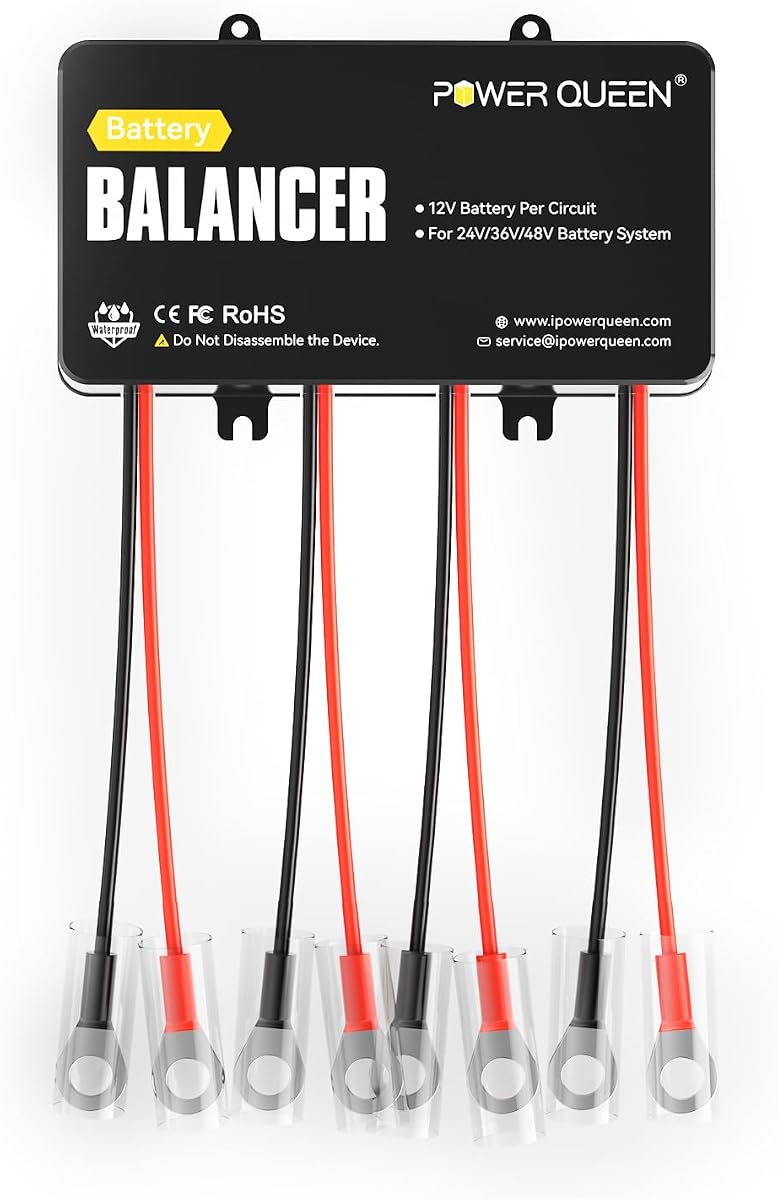
The Power Queen Battery Equalizer offers impressive value with broad voltage support and essential safety features. Users rate it highly for its ability to handle 24V to 48V systems without breaking the bank. It is a great choice for budget-conscious buyers who still need reliable balancing.
We may earn a commission when you buy through this link, at no additional cost to you.
It triggers automatically when voltage discrepancies exceed 10mV and provides a 5A compensation current. The unit includes reverse polarity protection and low voltage cutoff functions to safeguard battery health. Its indicator lights make it easy to verify the balancer is active and working.
While the 5A current is lower than premium active balancers, it suffices for many standard applications. The housing is basic and lacks advanced cooling features. These compromises keep the price low and make it accessible for casual users.
This model suits small to medium battery setups where cost is a primary concern. It ensures charge balance between series batteries effectively. If you want a no-frills solution that gets the job done, this is the best budget pick.
Triggers balancing automatically when voltage differences surpass 10mV to maintain system health.
Compatible with LiFePO4, lead acid, and other common chemistries for versatile usage.
We may earn a commission when you buy through this link, at no additional cost to you.
The MAZAVA Battery Equalizer HX02 features an integrated LCD monitor for real-time battery tracking. It earns a 4.1 rating for its advanced capabilities and premium build quality. This model is ideal for users who need detailed monitoring alongside active balancing.
We may earn a commission when you buy through this link, at no additional cost to you.
Its aluminum alloy shell ensures better heat dissipation during high load operations. The unit supports multi-module parallel connections, allowing expansion to higher voltage systems easily. The wide working voltage range of 7 to 18V per cell accommodates various battery types.
The higher price point reflects the premium features but may be steep for basic needs. Setup can be complex for users unfamiliar with parallel module connections. These downsides are minor for those who require precise monitoring and scalability.
This is the best choice for advanced users managing large battery banks with monitoring needs. It balances voltage in thousandths for fast equalization. If you want a professional-grade solution with a display, this is the top premium option.
The LCD display provides instant visual feedback on battery status and equalizer activity.
Aluminum alloy housing dissipates heat efficiently to maintain optimal operating temperatures.
We may earn a commission when you buy through this link, at no additional cost to you.
The Power Queen 48V Balancer is designed for intelligent auto-balancing that adapts to your battery bank. Users appreciate its 4.3 rating for reliability in off-grid and solar applications. It activates automatically when voltage differences exceed 10mV to keep batteries healthy.
We may earn a commission when you buy through this link, at no additional cost to you.
It supports 24V to 48V banks and offers high temperature and reverse polarity protection. The standby mode draws only 5mA to conserve energy when batteries are balanced. This makes it efficient for long-term continuous connection without draining the bank.
Careful wiring is required for series-parallel configurations to ensure optimal performance. A single unit is limited to 48V systems without parallel connection. These constraints are manageable with proper installation instructions.
This balancer is perfect for RV owners who need an automated solution for battery longevity. It works with LiFePO4 and lead acid chemistries effectively. If you want a smart device that balances automatically, this is a strong contender.
System detects voltage discrepancies and activates balancing to maintain equal charge states.
Standby mode consumes minimal energy to avoid draining the battery bank when balanced.
We may earn a commission when you buy through this link, at no additional cost to you.
The Victron Energy Battery Balancer is a classic choice for improving battery bank longevity. It holds a 4.2 rating and is trusted for its straightforward approach to balancing series connected batteries. It equalizes the state of charge when voltage exceeds 27 volts.
We may earn a commission when you buy through this link, at no additional cost to you.
This unit draws up to 1Amp to converge batteries to the same state of charge. It can be paralleled to support 48V banks effectively, offering flexibility in system design. Its simplicity makes it easy to install in standard 24V setups.
The 1A draw is lower than active balancers but sufficient for many small systems. It is limited to 24V per unit requiring multiple units for higher voltages. These limitations are acceptable for users who prefer proven technology.
This model is ideal for marine and mobile applications where reliability is key. It eliminates the effect of load imbalance to extend service life. If you want a trusted brand with simple operation, this is a reliable pick.
Compares series connected batteries to ensure they reach the same charge state.
Allows multiple balancers to connect in parallel for higher voltage bank support.
We may earn a commission when you buy through this link, at no additional cost to you.
This Battery Equalizer supports the widest voltage range from 12V up to 96V systems. It boasts a high 4.5 rating for its versatility in handling diverse battery chemistries. Users appreciate its ability to fit into distribution boxes with rail-type buckles.
We may earn a commission when you buy through this link, at no additional cost to you.
It is suitable for lead-acid, lithium, and nickel-cadmium batteries, making it highly versatile. The unit allows multiple parallel connections for large systems. It operates effectively when the single battery voltage is between 7V and 18V.
Installation requires ensuring each module corresponds to 2 batteries properly. The specific rail-type design may need compatible distribution boxes. These details are manageable for users setting up specialized high voltage systems.
This is the top pick for industrial and heavy-duty battery setups needing broad compatibility. It extends battery service life significantly. If you need a model that handles 96V and diverse chemistries, this is the best high voltage option.
Designed to work with battery systems ranging from 12V all the way to 96V.
Features a buckle installation method that allows easy mounting in distribution boxes.
We may earn a commission when you buy through this link, at no additional cost to you.
The 48V Battery Voltage Balancer features an LED display to simplify monitoring. It has a 3.7 rating and offers reverse polarity and low voltage disconnect features. It is useful for users who want visual confirmation of battery balance.
We may earn a commission when you buy through this link, at no additional cost to you.
It connects 4 x 12V batteries by default and supports both series and parallel setups. Multiple units can be connected for 96V systems. The unit protects against over discharge with low voltage disconnect functions.
The lower rating suggests some reliability concerns compared to other models. High voltage expansion requires multiple units which adds complexity. These trade-offs are acceptable if an LED display is a priority.
Ideal for hobbyists who need visual feedback during balancing operations. It protects batteries and extends service life. If you want a simple display and basic protection, this is a practical choice.
The LED display provides quick visual checks on the status of your battery bank.
Automatically disconnects to prevent over discharge and protect battery health.
We may earn a commission when you buy through this link, at no additional cost to you.
The Redodo Battery Balancer is tailored for 24V systems with strong 10A equalization current. It earns a high 4.4 rating for its reliable performance and included accessories like M8 OT terminals. It is a great choice for marine and off-grid setups.
We may earn a commission when you buy through this link, at no additional cost to you.
The LED display clearly shows voltage for both connected battery strings. It includes reverse and high temperature protection for safety. The unit extends battery life by maintaining balance without disassembly.
It is limited to 24V systems and does not support multi-module expansion. This restricts its use for higher voltage applications. These limits are acceptable for users focused on 24V setups.
This model is perfect for those needing a dedicated 24V solution with professional support. It maintains balance effectively and improves endurance. If you need a reliable 24V balancer, this is a top pick.
Maximum equalization current of 10A ensures quick and effective voltage correction.
Comes with M8 OT terminals for secure and professional connection to battery strings.
We may earn a commission when you buy through this link, at no additional cost to you.
The Power Queen Equalizer supports 24V to 48V banks with active balancing technology. It receives a 4.1 rating and is designed for reliable operation in diverse settings. It activates automatically to balance voltage differences efficiently.
We may earn a commission when you buy through this link, at no additional cost to you.
Features include high temperature protection and a low power standby mode to conserve energy. The unit is suitable for RVs and off-grid power systems. It ensures long-term connection without performance drops.
Mid-range pricing and standard build quality are common for this segment. It requires careful wiring for series-parallel setups. These considerations are minor for most users seeking reliable performance.
Ideal for users needing a versatile balancer for multiple voltage systems. It prolongs battery life with active tech. If you need a flexible solution, this is a strong pick.
Enhances battery performance significantly with advanced active balancing technology.
Low power standby mode conserves energy while maintaining battery balance.
We may earn a commission when you buy through this link, at no additional cost to you.
The HA01 Battery Equalizer features an LED display and 5A compensation current. It has a 4.3 rating and supports N x 12V systems easily. Users like its simple connection and durable flame retardant shell.
We may earn a commission when you buy through this link, at no additional cost to you.
It balances batteries when voltage difference is 20mV. The unit protects batteries and improves degree and life. Installation is straightforward with clear color-coded wires.
The 5A current is moderate compared to high current options. The housing is basic but functional for typical environments. These trade-offs are acceptable for budget-conscious buyers.
Perfect for users needing visual feedback and moderate balancing power. It works for 24V, 36V, and 48V systems. If you want a display and simple setup, this is a great choice.
LED digital display allows convenient voltage checks without extra tools.
Constructed with flame retardant materials for safety during installation and operation.
We may earn a commission when you buy through this link, at no additional cost to you.
Selecting the right battery equalizer requires considering your battery bank voltage, chemistry, and usage patterns. This guide outlines the key factors to ensure you choose a reliable and efficient model.
Ensure the balancer supports the total voltage of your battery bank. Many models support up to 48V but some handle up to 96V for larger systems. Always check the max voltage rating to avoid damaging the unit.
Look for a model that explicitly states compatibility with your system voltage.
Different chemistries like LiFePO4, AGM, and Gel require specific balancing algorithms. Some balancers are universal while others are optimized for lead-acid or lithium. Choosing the wrong type can lead to poor performance or damage.
Select a universal balancer that lists your specific battery chemistry as supported.
The maximum compensation current determines how fast the unit equalizes voltage differences. Models with 10A current are faster than those with 5A or 1A. Higher current is beneficial for large capacity batteries.
Prioritize higher current models for larger batteries to minimize balancing time.
Essential protections include reverse polarity, over-temperature, and low-voltage cutoff. These features prevent damage from wiring mistakes or overheating. A robust safety system extends the life of both the balancer and batteries.
Always choose a model with at least reverse polarity and temperature protection.
Consider the mounting style and terminal types. Rail-type buckles fit distribution boxes easily while screw terminals allow custom wiring. Also check if the unit supports parallel expansion for higher voltages.
Ensure the physical design matches your available space and connection needs.
A balancer that stays connected constantly should consume minimal power. Low standby power like 5mA prevents unnecessary discharge when batteries are balanced. This is crucial for off-grid systems where every amp hour counts.
Look for low standby power ratings to avoid draining your battery bank.
Choose brands with proven track records in power electronics. Established manufacturers often provide better quality control and warranty support. Reliable brands reduce the risk of early failures.
Read reviews and check warranty terms before finalizing your purchase.
Some models include LED or LCD displays to visualize battery status. Monitoring helps confirm that balancing is active and allows you to detect issues early. This feature adds value for complex battery setups.
Consider a model with a display if you want real-time feedback.
First, connect the balancer to the battery bank terminals carefully. Match positive and negative wires correctly to utilize reverse polarity protection. Ensure the middle wire connects to the junction between the batteries in series.
Second, mount the unit in a cool dry location for better heat dissipation. Avoid direct sunlight or confined spaces to prevent overheating. Use the included terminals or appropriate connectors for secure contact.
Third, check the indicator lights or displays periodically. If the unit does not activate or shows errors, inspect connections. Clean terminals occasionally to maintain good conductivity and prevent resistance issues.
Balancers are primarily designed for series connected batteries to balance voltage differences. Parallel batteries naturally equalize voltage but can have current imbalances. Using a balancer in parallel configurations depends on the specific model instructions.
A battery equalizer detects voltage differences between connected batteries. It draws current from the higher voltage battery to charge the lower one until they match. This process maintains equal state of charge across the bank.
Many modern balancers support multiple chemistries including lead-acid and lithium. However it is vital to verify the product specifications for your specific battery type. Using incompatible chemistries can affect performance.
Most balancers are designed for permanent connection with low standby power. They activate only when voltage differences are detected. This allows continuous monitoring without significant drain on your battery bank.
Many units include reverse polarity protection to prevent damage from incorrect wiring. However it is still best to double check connections before powering the system. Repeated errors can eventually bypass safety circuits.
Some units support 48V directly while others are limited to 24V per unit. For 48V with 24V rated balancers you may need two units connected in parallel. Check the product specs for system limits.
Many models feature LED indicators or displays to show active status. If the voltage difference between batteries decreases over time it is working correctly. Refer to the manual for specific indicator meanings.
Routine maintenance involves checking connections for corrosion and ensuring ventilation. Cleaning terminals helps maintain conductivity. Avoid exposing the unit to excessive dust or moisture to extend its lifespan.
We reviewed ten top models ranging from budget-friendly options to premium units with monitors. Each pick offers unique strengths for different battery bank sizes and chemistries. Your specific needs should guide your final selection.
Prioritize safety features and current capacity when making your decision. Ensure the unit is compatible with your battery voltage and chemistry to avoid issues. Balancing helps significantly extend battery life and performance.
Prices and availability change frequently so check current offers before purchasing. Verify the warranty and support details with the seller. Selecting the right balancer now ensures reliable power for your system for years.