
GIGABYTE GeForce RTX 5080 Gaming OC 16G
4.6Editor score
NVIDIA Blackwell architecture
16GB GDDR7 memory
WINDFORCE Cooling System
Compare the top 10 Graphics Cards for Ray Tracing in October 2026 with expert reviews, specs, and performance insights for gaming and creative workloads.
Choosing the right Graphics Cards for Ray Tracing is essential for immersive gaming and high fidelity visual work. These GPUs unlock realistic lighting, shadows, and reflections that transform virtual worlds into stunning digital experiences.
We analyzed performance benchmarks thermal cooling efficiency, and architectural advancements to curate this list. Our comparison covers leading models from NVIDIA and AMD, ensuring you find a card that meets your specific rendering and gaming needs.
Each pick highlights unique strengths like DLSS 4 integration or advanced thermal pads. Prices fluctuate frequently, so verify current availability before purchasing. Read on to discover which GPU delivers the best value for your setup.
4.6Editor score

4.8Editor score

4.7Editor score
This table provides a side-by-side look at all ten graphics cards. Compare memory, architecture, and key features to decide which GPU fits your budget and performance requirements for ray tracing.



The GIGABYTE GeForce RTX 5080 Gaming OC 16G stands as a top-tier option for serious gamers. Rated highly for its performance, it leverages the Blackwell architecture to deliver exceptional ray tracing capabilities.
We may earn a commission when you buy through this link, at no additional cost to you.
Its 16GB GDDR7 memory ensures smooth handling of high-resolution textures. The WINDFORCE cooling system maintains optimal temperatures even during intense gaming sessions.
While the cost is significant, the longevity and performance justify the investment. You gain access to the latest DLSS 4 technology for better visual fidelity.
This card is ideal for enthusiasts seeking the best ray tracing experience. If budget allows, it is the definitive choice for future-proofing your rig.
The WINDFORCE system uses multiple fans to dissipate heat efficiently, ensuring stable clock speeds under load.
With GDDR7, texture loading times are reduced, allowing for seamless open-world exploration without stuttering.
We may earn a commission when you buy through this link, at no additional cost to you.
The GIGABYTE Radeon RX 9070 XT offers incredible value for builders on a budget. It brings competitive performance and strong features to the mid-range market.
We may earn a commission when you buy through this link, at no additional cost to you.
Its 16GB GDDR6 memory handles modern titles well. The server-grade thermal conductive gel improves heat transfer from the GPU to the cooler.
While ray tracing may not match NVIDIA's top tier, it remains viable for many games. You get plenty of power without breaking the bank.
Buy this if you need high resolution performance at a lower cost. It balances features and affordability effectively for most gamers.
The Hawk fan design and conductive gel keep temperatures low even during extended play sessions.
16GB of VRAM ensures you can run high texture settings without worrying about memory bottlenecks.
We may earn a commission when you buy through this link, at no additional cost to you.
ASUS TUF Gaming GeForce RTX 5070 Ti earns its Editor's Choice title with balanced performance and durability. It uses the Blackwell architecture for efficient rendering.
We may earn a commission when you buy through this link, at no additional cost to you.
Military-grade components and protective PCB coating ensure longevity. The phase-change thermal pad maintains consistent cooling under heavy loads.
The design is robust but may not fit smaller cases. It delivers a premium experience for those who prioritize stability.
Choose this card for a reliable long-term gaming solution. It offers top-tier features without compromising on build quality.
Military-grade parts and Auto-Extreme manufacturing ensure the card withstands rigorous use over time.
Phase-change pads provide better thermal conductivity than traditional pastes, reducing hotspot risks.
We may earn a commission when you buy through this link, at no additional cost to you.
The ASUS Prime Radeon RX 9070 XT brings quality engineering to the mid-range segment. Axial-tech fans improve airflow while keeping noise levels manageable.
We may earn a commission when you buy through this link, at no additional cost to you.
Phase-change thermal pads enhance heat transfer. This reduces overall GPU temperatures for better stability during gaming.
The 0dB technology allows silent operation during light loads. This is great for mixed-use systems like office or gaming rigs.
It is a solid choice for those who need reliable cooling. Ensure your case has enough clearance for its 2.5-slot design.
Smaller fan hubs allow longer blades, increasing downward air pressure for better cooling efficiency.
0dB technology stops fans when idle, reducing noise during non-demanding tasks.
We may earn a commission when you buy through this link, at no additional cost to you.
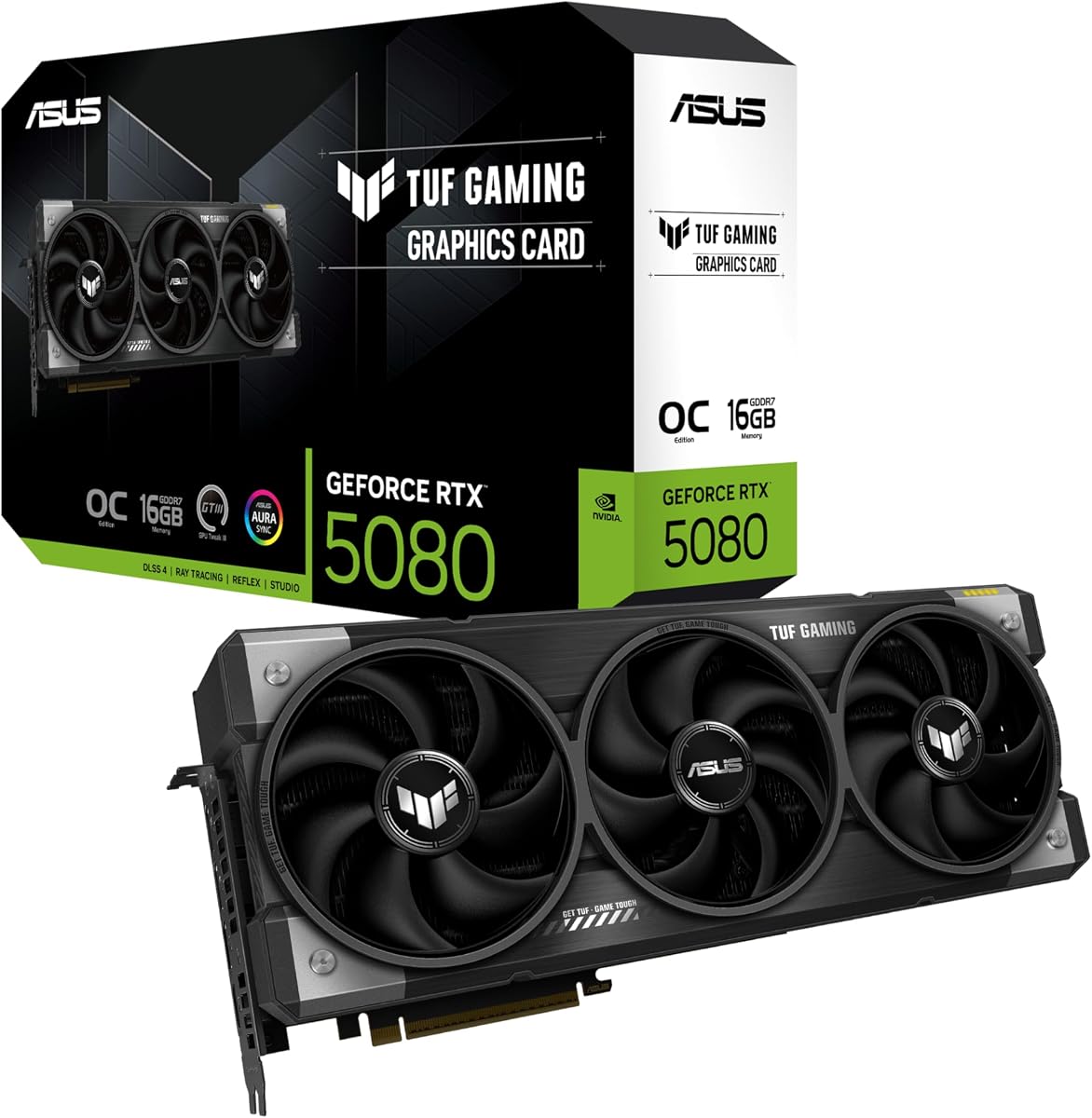
This ASUS TUF GeForce RTX 5080 provides top-end power for 4K ray tracing. It includes protective PCB coating to guard against moisture and dust.
We may earn a commission when you buy through this link, at no additional cost to you.
Military-grade components deliver rock-solid power. This ensures stability for demanding workloads and extended gaming sessions.
Phase-change thermal pads optimize performance and longevity. They prevent overheating under heavy stress better than standard pastes.
This card is for users needing maximum performance. Check your power supply and case dimensions before purchasing.
Protective PCB coating shields the board from corrosive elements, enhancing the card's lifespan.
GPU Tweak III software provides intuitive performance tweaks and monitoring to maximize frame rates.
We may earn a commission when you buy through this link, at no additional cost to you.
The ASUS Dual GeForce RTX 5060 Ti is great for smaller builds. Its 2.5-slot design fits well in most standard cases.
We may earn a commission when you buy through this link, at no additional cost to you.
Powered by Blackwell architecture and DLSS 4, it handles modern games efficiently. The AI performance metrics show strong throughput.
Dual ball fan bearings last twice as long as sleeve designs. This increases reliability and reduces maintenance over time.
Ideal for compact gaming setups needing high VRAM. It balances size and capability for smaller footprint builds.
The 2.5-slot design ensures compatibility with smaller PC cases without sacrificing cooling efficiency.
Dual ball bearings significantly extend the life of fans compared to standard sleeve bearings.
We may earn a commission when you buy through this link, at no additional cost to you.
The ASUS TUF GeForce RTX 5070 brings balanced performance for 1440p gaming. It features a robust build with military-grade components.
We may earn a commission when you buy through this link, at no additional cost to you.
GPU Guard secures the GPU, reducing risk of cracks. This ensures stable mounting in cases where vibration occurs.
Protective PCB coating guards against moisture. This adds an extra layer of protection for long-term reliability.
A solid choice for users needing reliability without top-tier cost. Verify compatibility with your PSU before installation.
GPU Guard and the included bracket secure the card firmly to prevent flex or cracks.
Phase-change thermal pads provide better heat transfer than traditional pastes for consistent performance.
We may earn a commission when you buy through this link, at no additional cost to you.
ASUS Dual Radeon RX 9060 XT offers excellent VRAM for its class. The 16GB memory helps with high texture settings.
We may earn a commission when you buy through this link, at no additional cost to you.
Axial-tech fans provide robust cooling while staying quiet. This makes it suitable for home office setups too.
Dual BIOS lets you toggle between performance and quiet modes. This flexibility is rare in standard cards.
Choose this for general gaming with good longevity. Check your budget as prices may change frequently.
Smaller hubs on fans allow longer blades for better air pressure and cooling performance.
0dB technology lets you enjoy light gaming in relative silence without unnecessary fan noise.
We may earn a commission when you buy through this link, at no additional cost to you.
The GIGABYTE RTX 5070 delivers strong 1440p performance with ray tracing. It supports the latest Blackwell architecture and DLSS 4.
We may earn a commission when you buy through this link, at no additional cost to you.
GDDR7 memory provides high bandwidth for smooth gameplay. This helps maintain stability in complex scenes.
WINDFORCE cooling keeps the system stable. It ensures temperatures stay within safe limits during long sessions.
A good pick for users needing strong performance. Check current pricing as costs can vary.
192-bit GDDR7 interface offers fast data transfer rates for quick texture loading.
PCIe 5.0 ensures compatibility with modern motherboards for optimal data throughput.
We may earn a commission when you buy through this link, at no additional cost to you.
The ZOTAC RTX 4070 Super Twin Edge is a compact powerhouse. It supports full ray tracing and DLSS 3 for better frame rates.
We may earn a commission when you buy through this link, at no additional cost to you.
Boost clock speeds are strong for mid-range gaming. This card handles modern titles at 1440p efficiently.
IceStorm 2.0 cooling keeps temperatures low. It ensures reliable performance even during extended sessions.
Choose this if you need a smaller card. Ensure your PSU meets the minimum power requirements.
IceStorm 2.0 Advanced Cooling features dual fans to maintain optimal thermal levels.
Multiple DisplayPort and HDMI outputs support 4 display setups for versatile use cases.
We may earn a commission when you buy through this link, at no additional cost to you.
Selecting the right GPU requires understanding architecture, memory, and cooling. This guide explains what to consider before buying.
Modern cards use architectures like Blackwell and Ada Lovelace which provide dedicated ray tracing cores. Look for cards that support DLSS 4 or similar upscaling technologies for better performance.
Prioritize newer architectures to ensure better efficiency and longevity.
Ray tracing increases memory demand due to complex shading. Aim for at least 12GB or 16GB of GDDR7 or GDDR6X VRAM.
Higher capacity prevents stuttering in open-world titles.
High performance generates heat, so robust cooling is essential. Look for cards with multiple fans and phase-change thermal pads.
Effective cooling ensures sustained boost clocks.
Ensure the card fits in your case. Check clearance dimensions like length and slot width before purchasing.
Measure your case carefully to avoid fit issues.
Newer GPUs often need higher wattage PSUs. Verify your power supply supports the required connectors like 12V-2×6.
Adequate power ensures system stability.
Balance cost with performance needs. Budget cards may offer lower ray tracing efficiency compared to premium models.
Choose a model that fits your specific use case.
Features like PCB coating and metal brackets protect your investment. Military-grade components add longevity to the card.
Durability is key for long-term reliability.
Good GPU software allows performance tweaking and monitoring. Ensure the card comes with utilities like GPU Tweak III.
Software support adds flexibility for tuning.
Install your GPU in a stable PCIe slot and secure it with screws. Connect the necessary power cables from your PSU to the card.
Update drivers regularly to ensure compatibility with new games. Use manufacturer software to monitor temperatures and fan speeds.
Clean dust from the cooling system every few months. Ensure airflow in your case remains unobstructed for optimal performance.
The NVIDIA RTX 5080 offers top performance for ray tracing with its Blackwell architecture. For better value, the RTX 5070 Ti provides strong results without the premium price tag.
16GB VRAM is recommended for high-resolution textures in modern games. While 12GB works for many titles, 16GB ensures smoother performance in demanding scenarios.
Ray tracing adds load to the GPU increasing power draw. Ensure your PSU is at least 750W for mid-range and 850W for high-end cards.
AMD cards have improved but still lag behind NVIDIA in ray tracing efficiency. They are great for traditional rasterization if budget is a concern.
DLSS 4 is NVIDIA's AI upscaling technology that improves frame rates while maintaining image quality. It is essential for smooth ray tracing performance.
Use software like GPU Tweak III or HWMonitor to check temperatures. Ideal idle temps are below 50C and load temps below 85C.
We reviewed 10 top GPUs offering powerful options for ray tracing. The RTX 5080 leads in raw power while the RX 9070 XT balances cost effectively.
Prioritize cooling and memory capacity when selecting a card. Your choice depends on your specific gaming and resolution needs.
Always check current pricing and availability before buying. Prices fluctuate regularly so verify deals before finalizing your purchase.