
ESP8266 ESP-01
4.4Editor score
Low Cost Option
3 Modes Supported
4MB Flash Memory
This comprehensive guide compares the top Arduino WiFi Module options for 2026, evaluating connectivity, performance, and features to help you choose the right
Finding the right Arduino WiFi Module is essential for modern IoT and embedded development. Whether you are building smart home devices or industrial sensors, reliable wireless connectivity ensures your projects communicate effectively with networks and the cloud.
We have evaluated ten leading options based on connectivity standards, processing power, ease of use, and community support. This list covers everything from budget-friendly add-on boards to full-featured microcontrollers with integrated wireless capabilities.
Each pick highlights specific strengths like dual-core performance, USB-C support, or compact form factors. While product availability and details may shift, this guide provides a stable reference for selecting the best hardware for your needs.
4.4Editor score

4.7Editor score

4.7Editor score
The following table provides a side-by-side overview of the top ten Arduino WiFi Module selections. It highlights key specifications such as memory, connectivity protocols, and unique features to simplify your decision-making process.



The Arduino UNO R4 WiFi represents a significant leap forward in the classic UNO form factor. Boasting a rating of 4.7 stars, it combines the reliability of the Renesas RA4M1 with the wireless prowess of the ESP32-S3. This dual-core architecture allows for complex tasks like AI at the edge while maintaining seamless connectivity.
We may earn a commission when you buy through this link, at no additional cost to you.
Its standout features include a 12×8 LED matrix for immediate visual feedback without external components. The integration of CAN bus makes it suitable for automotive and industrial projects. Additionally, the Qwiic connector simplifies I2C sensor wiring, reducing the clutter of jumper wires common in prototype setups.
While the board is more expensive than traditional add-on shields, the integration justifies the cost for serious developers. The USB-C port ensures modern compatibility, and the 12-bit DAC provides high-fidelity analog output for audio or control applications. These trade-offs are acceptable for users needing a complete solution.
Buyers seeking a robust platform for advanced IoT applications should consider this board first. It is ideal for those moving beyond simple blink projects into industrial automation or smart home hubs. The balance of processing power and connectivity makes it a top recommendation.
With Wi-Fi and Bluetooth 5.0 built-in, you avoid extra modules. This ensures stable communication with mobile apps or cloud platforms effortlessly.
The Qwiic connector and LED matrix allow for rapid development cycles. You can prototype complex sensor arrays quickly without soldering.
We may earn a commission when you buy through this link, at no additional cost to you.
This offering from HiLetgo provides three ESP8266 modules, making it excellent for multiple prototypes. The 4.2 rating reflects its solid performance for basic connectivity tasks. These modules act as wireless transceivers, bridging the gap between your microcontroller and Wi-Fi networks.
We may earn a commission when you buy through this link, at no additional cost to you.
They support AP, STA, and combined modes, offering flexibility in network configuration. The inclusion of LWIP simplifies TCP/IP stack handling in firmware. While they lack direct USB connections, they work well with UART interfaces on boards like Arduino Uno.
Keep in mind these modules run on 3.3V logic and may need level shifters for 5V boards. They also require careful wiring for stable operation. Despite these minor hurdles, the price per unit makes them a fantastic entry point for learning wireless concepts.
Ideal for hobbyists needing multiple units for a sensor network, this pack saves time and money. It serves as a cost-effective way to test ideas before committing to more integrated boards. The simplicity of the design allows for deep customization.
AP and STA modes let the device act as a hotspot or connect to routers. This versatility is key for diverse IoT scenarios.
Compatible with Arduino IDE via serial commands, it reduces setup friction. Users can quickly flash code and test connectivity.
We may earn a commission when you buy through this link, at no additional cost to you.
The ESP-01S is a refined version of the classic module, featuring a 4MB flash memory for storing more firmware. With a 4.4 rating, it is trusted for its improved signal strength compared to earlier revisions. This makes it reliable for projects where distance from the router matters.
We may earn a commission when you buy through this link, at no additional cost to you.
You must select the Generic ESP8266 Module board in Arduino IDE for programming. The module uses a serial interface which requires an FTDI adapter for flashing. However, once configured, it offers robust Wi-Fi performance for sensor data transmission.
One trade-off is the lack of pins for expansion directly on the module. It is best suited for specific wireless tasks rather than general I/O expansion. But for a dedicated Wi-Fi client, its compact size is a major advantage.
This module is perfect for battery-powered projects needing long-range communication. Its small footprint fits into tight enclosures easily. Developers looking for a proven workhorse should consider this version for its stability and memory capacity.
4MB flash allows for storing SSL certificates and more code. This enables secure connections without external storage.
The improved antenna design ensures better reception. This translates to fewer dropouts in challenging environments.
We may earn a commission when you buy through this link, at no additional cost to you.
Aitrip offers a five-pack of ESP8266 modules, ideal for large-scale sensor deployments. With a 4.4 rating, these units are reliable for sending periodic data. The 1MB SPI flash is sufficient for basic telemetry apps without heavy features.
We may earn a commission when you buy through this link, at no additional cost to you.
They support standard AT commands, allowing communication from almost any microcontroller. This compatibility makes them versatile for mixed-platform projects. The modules can run on NodeMCU or standard Arduino systems with voltage level shifting.
Be careful with power; these only support up to 3.6V and require stable current. Using 5V directly can damage the chips. But if managed correctly, they offer a cost-effective way to equip multiple nodes with internet access.
Choose this pack if you need to wire multiple remote sensors. The bulk pricing reduces cost per unit significantly. It is a practical choice for smart lighting grids or environmental monitoring stations.
Five units allow for building redundant networks easily. This is useful for testing signal reliability across different locations.
AT commands provide a universal interface for configuration. This makes them accessible to users of various hardware platforms.
We may earn a commission when you buy through this link, at no additional cost to you.
ELEGOO presents a trio of ESP32 boards, offering superior performance over ESP8266 alternatives. Rated at 4.7, they feature a dual-core processor capable of 240 MHz. This speed is crucial for handling both wireless data and complex logic simultaneously.
We may earn a commission when you buy through this link, at no additional cost to you.
Built-in Bluetooth 4.2 allows for dual connectivity options. You can pair with mobile devices while maintaining a Wi-Fi connection to a server. The USB-C port simplifies powering and programming, offering modern convenience.
Over-the-air updates mean you can patch firmware remotely, avoiding manual reflashes. This is a vital feature for deployed devices. However, note that the USB cable is sold separately which adds to initial setup costs.
For projects requiring high throughput or Bluetooth features, these boards are unmatched. They are perfect for interactive displays or smart home hubs. The multi-pack ensures you always have a spare for rapid prototyping.
Split tasks between cores for smooth performance. One can handle Wi-Fi while the other manages sensors.
OTA support ensures your device stays secure. It allows for feature additions without physical access to the unit.
We may earn a commission when you buy through this link, at no additional cost to you.
The Nano ESP32 packs immense power into a tiny chassis. With a 4.5 rating, it is perfect for wearable tech and portable gadgets. It uses the ESP32-S3 which brings AI capabilities and fast Bluetooth 5.0 for efficient data transfer.
We may earn a commission when you buy through this link, at no additional cost to you.
A unique feature is its Human Interface Device support. You can create custom keyboards or mice using this board. Combined with MicroPython compatibility, it allows rapid prototyping for non-C++ users.
Note this version comes without headers so soldering is required. This limits it to permanent installations rather than breadboards. However, the small size allows it to fit in wearable bands or custom enclosures.
This board is ideal for advanced users building custom peripherals. It offers a blend of official Arduino reliability and modern ESP32 features. Choose it if you need a compact, high-performance wireless module.
HID support enables input devices. This transforms the board into a versatile interface for computers.
MicroPython makes coding easier for beginners. It allows for interactive coding sessions and quick testing of logic.
We may earn a commission when you buy through this link, at no additional cost to you.
This 4-pack of ESP-01S modules is excellent for wearable electronics or sensor arrays. The units are made of durable material and can be reused across projects. Their self-calibrated RF ensures optimal performance in small packages.
We may earn a commission when you buy through this link, at no additional cost to you.
They are ideal for scenarios needing location sensing or smart home automation. The compact design allows them to be hidden inside custom cases. With consistent connectivity, they provide reliable data transmission for monitoring apps.
These are basic transceivers without extra features like LCD drivers. They serve strictly to bridge wireless data. But for their intended purpose, they are cost-effective and easy to integrate into prototypes.
Buyers needing a set of reliable wireless nodes should consider this bundle. It is a great value for distributed sensor networks. The quality of construction makes them a preferred choice for repeated use.
Calibrated RF means less signal loss. This helps maintain a stable connection over longer distances.
Durable materials ensure longevity. These modules can withstand the rigors of prototyping and testing.
We may earn a commission when you buy through this link, at no additional cost to you.
These modules feature 4MB flash memory and support the DOUT protocol. With a 4.5 rating, they are known for stability in IoT applications. The 115200 baud rate ensures fast data transmission during development.
We may earn a commission when you buy through this link, at no additional cost to you.
When programming, you must set the SPI mode to DOUT in the IDE. This technical detail ensures correct flashing. Once configured, they offer solid performance for transmitting large data sets over Wi-Fi.
They strictly support 3.3V so care must be taken with power sources. This voltage limit is standard for this chip but requires a stable regulator. Despite the requirement, they are reliable for continuous operation.
Choose these if you need a higher data rate or flash memory. They suit data logging projects where speed matters. The five-pack offers flexibility for testing different configurations.
DOUT protocol is standard for ESP chips. This ensures compatibility with most development tools and IDEs.
A baud rate of 115200 speeds up logging. This reduces latency when sending frequent sensor updates.
We may earn a commission when you buy through this link, at no additional cost to you.
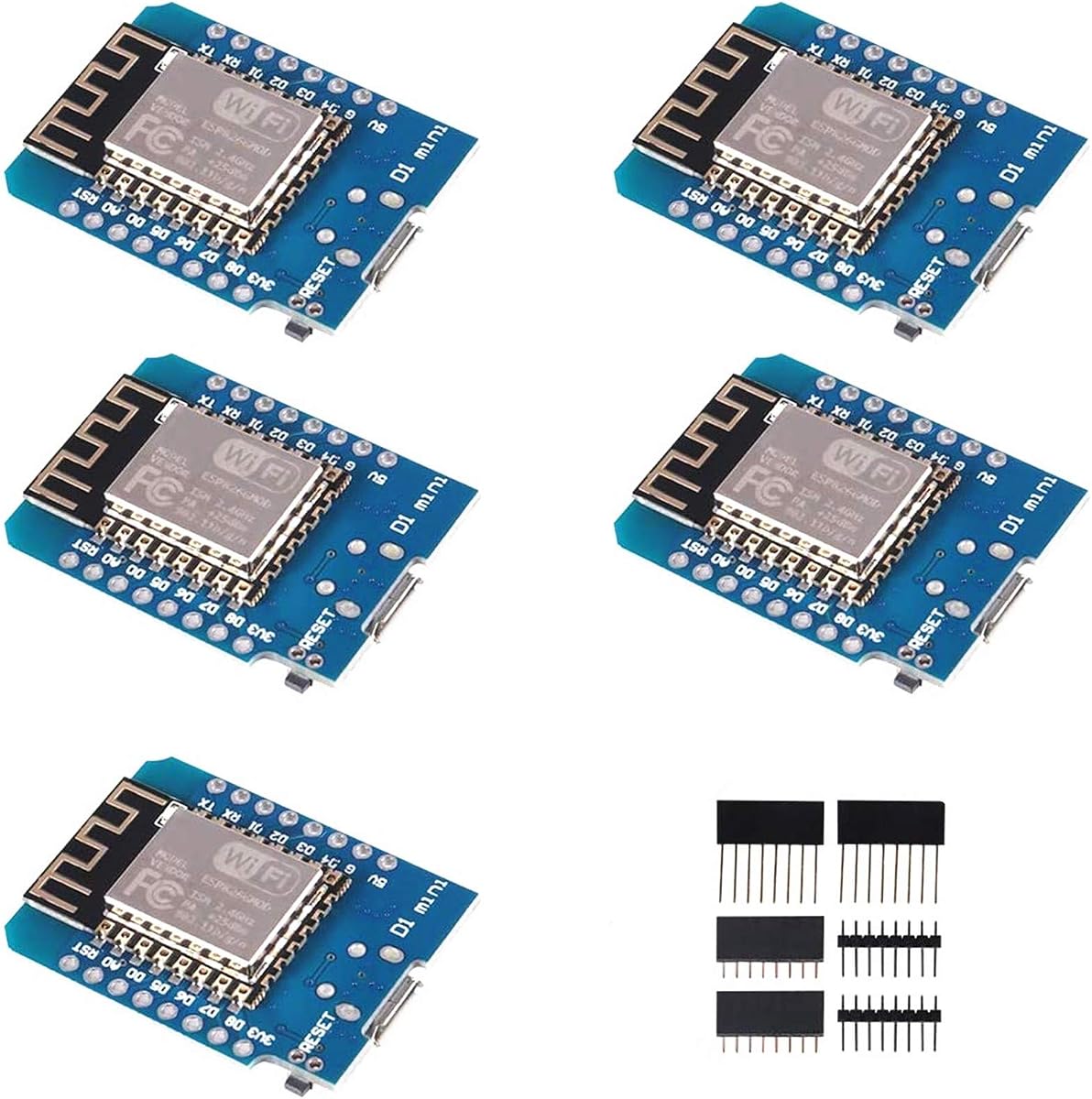
This bundle includes D1 mini boards based on ESP8266. With 11 GPIO pins, they offer more I/O flexibility than standard modules. They also come with Micro USB for easy programming without extra adapters.
We may earn a commission when you buy through this link, at no additional cost to you.
Features like PWM and I2C support make them versatile for sensors and displays. The 4M byte storage allows for complex Lua or Arduino sketches. Additionally, a resettable fuse protects against power surges.
These boards are fully compatible with Arduino IDE and WeMos ecosystems. They allow for rapid prototyping due to their built-in regulators. However, the Micro USB ports can be fragile if not handled carefully.
For projects needing multiple input pins or power regulation, these are ideal. They suit smart home sensors that require more connectivity. The package of five makes them suitable for distributed systems.
11 digital pins allow for complex wiring. This reduces the need for external multiplexers in projects.
Onboard switching supply simplifies wiring. You can power the board directly from 5V without regulators.
We may earn a commission when you buy through this link, at no additional cost to you.
This 10-pack holds a perfect 5.0 rating, indicating high reliability. Each unit supports LWIP and offers ample storage for data retention. The bundle is ideal for large projects needing many nodes simultaneously.
We may earn a commission when you buy through this link, at no additional cost to you.
They provide distinct modes like AP and STA for versatile networking. The onboard processing capabilities allow for local tasks without relying on external controllers. This makes them potent solutions for scalable systems.
Be aware they require careful voltage handling. They operate best on 3.3V. But once configured, they offer robust connectivity that can handle complex algorithms efficiently.
Opt for this bulk pack when building sensor networks. The cost efficiency allows for deploying devices across a large area. With this many units, you can ensure redundancy and failover in your system.
A perfect rating suggests few user complaints. This points to reliable manufacturing and quality control standards.
AP and STA modes support versatile setups. This allows the device to act as a client or a router.
We may earn a commission when you buy through this link, at no additional cost to you.
Selecting the right module depends on your project requirements and budget. We have identified key factors that impact performance and usability.
Evaluate if you need Wi-Fi only or Bluetooth too. Modules like the ESP32 offer both which expands device compatibility. Ensure the range meets your deployment environment.
Choose boards with Bluetooth for mobile app interactions. For pure internet data, Wi-Fi-only modules suffice and save power.
Dual-core processors handle complex tasks better than single-core ones. If your project runs AI or multiple services, look for higher MHz ratings. Single cores are fine for simple sensor data.
Select higher clock speeds for advanced logic. Basic tasks can run on lower-end chips without sacrificing performance.
Battery-powered projects require low-power sleep modes. Check if the module supports deep sleep. Some models are optimized for energy efficiency better than others.
Prioritize modules with power-saving features. This extends battery life significantly in remote locations.
Modern USB-C ports simplify wiring and programming. Boards with built-in regulators reduce external circuit needs. This speeds up the development process immensely.
Choose boards with integrated regulators and USB ports. They save time and reduce errors in breadboard setups.
Flash memory determines how much code and data you store. 4MB allows for secure certificates and larger libraries. 1MB might be enough for simple scripts.
Opt for at least 4MB flash if possible. It future-proofs your project against code growth.
Some modules offer extra pins for sensors and displays. Qwiic connectors simplify wiring compared to jumper wires. Check how many GPIO pins are available.
Select boards with more GPIOs and connectors. They reduce the need for external multiplexers or breakout boards.
Popular boards have vast libraries and tutorials. This helps when troubleshooting issues or finding examples. Community support is critical for beginners.
Choose platforms with active communities. This ensures you can find help easily if stuck.
Most wireless modules run on 3.3V logic. Ensure your power supply is stable to avoid resets. Using 5V directly can damage the chip.
Always verify voltage limits before powering. Use a regulator if your supply does not support 3.3V.
To get started, connect the module to a computer using a USB-C or Micro USB cable if available. Install the Arduino IDE and select the correct board type for your specific module. This ensures the compiler matches your hardware architecture.
Ensure you have the correct voltage regulator. Most modules require 3.3V. If using a 5V board, insert a logic level shifter. This prevents damage to the sensitive internal circuits.
Store unused modules in anti-static bags to prevent corrosion. Excess humidity can degrade the components over time. Keep them dry and away from direct sunlight to maintain longevity.
Many boards have built-in USB-to-UART bridges so you do not need a separate adapter. However, smaller modules like the ESP-01 require an FTDI or CP2102 adapter to connect to your computer. Check the board details to confirm.
STA mode connects the device to a router as a client. AP mode makes the module act as its own hotspot for other devices. You can use both simultaneously for more complex network setups.
Yes, they connect via UART or SPI to the Pi. You can use the serial console or libraries to communicate with them. They are versatile enough to work with many platforms.
No, most wireless modules operate at 3.3V. Connecting 5V directly can damage the chip. You must use a voltage regulator or logic level shifter for safe operation.
OTA updates require the device to be connected to Wi-Fi. You upload a new firmware version to a server. The module downloads and flashes it automatically. This is supported on ESP32 boards.
Yes, most modern modules support SSL/TLS encryption. You need to load certificates into the flash memory. This secures data sent between the device and cloud servers.
We reviewed ten excellent options ranging from the high-end Arduino UNO R4 to cost-effective ESP8266 packs. Each choice serves different needs from industrial automation to simple sensor logging.
Prioritize features like dual-core processing or USB-C if you value speed and convenience. For bulk projects, consider the ESP8266 bundles for their economy.
Always check current stock and support resources before purchasing. Technology moves quickly so verify the latest specs to ensure compatibility with your goals.