
LAFVIN R3 Camera Smart Robot Car Compatible with Arduino IDE
4.5Editor score
Wireless Wi-Fi Control
Open-Source Code
Easy Assembly
This guide compares the top 10 Arduino robot kits for kids and adults, evaluating features like sensors, coding compatibility, and build quality to help you
Arduino robot kits offer an exciting way to learn electronics and coding through hands-on assembly. These kits transform abstract concepts into tangible projects that move and interact with their environment. Whether you are a student or a hobbyist, building a robot fosters critical thinking and technical skills essential for the future.
We evaluated ten leading Arduino robot kits based on build quality, sensor variety, and programming flexibility. Our analysis focuses on how well each kit supports learning from basic assembly to advanced customization. We considered user feedback and technical specifications to ensure every recommendation delivers real educational value and reliability.
Each pick below highlights a unique strength, from beginner-friendly designs to advanced tracking capabilities. You will find detailed breakdowns of features, pros, and cons to help you decide. Note that product availability and pricing can change frequently, so always verify current details before purchasing your next project.
4.5Editor score

4.5Editor score

4.3Editor score
The following comparison table provides a side-by-side view of the top ten Arduino robot kits available today. Each entry lists key specifications to help you quickly identify the model that best fits your specific needs and skill level.


The ELEGOO UNO R3 Smart Robot Car Kit V4 stands out as the most balanced option for beginners and intermediate users. With a rating of 4.5 stars, it delivers reliable performance and a rich feature set including an onboard camera. This kit transforms coding and electronics into a tangible, drivable experience that engages learners effectively.
We may earn a commission when you buy through this link, at no additional cost to you.
Its standout feature is the FPV capability, allowing users to see what the robot sees through a Wi-Fi connected camera. The keyed XH2.54 connectors significantly reduce wiring errors, making assembly much smoother for novices. The included tutorial provides step-by-step guidance from chassis assembly to the first successful drive.
While the kit includes a rechargeable battery, users may find the range limited for extensive outdoor sessions. The wheels are standard size, which can struggle on thick carpets or uneven terrain. However, these minor drawbacks are outweighed by the robust educational value and the ability to expand with custom code.
This kit is ideal for STEM classrooms, makerspaces, or families looking for a weekend project that teaches real engineering principles. Whether you are teaching children to code or refining your own Arduino skills, this kit provides the perfect platform for learning and creativity.
The onboard camera allows you to view the robot’s perspective on your phone, enhancing navigation and control experiences.
You can modify the example code to create custom routes or add new sensors using the versatile Arduino IDE environment.
We may earn a commission when you buy through this link, at no additional cost to you.
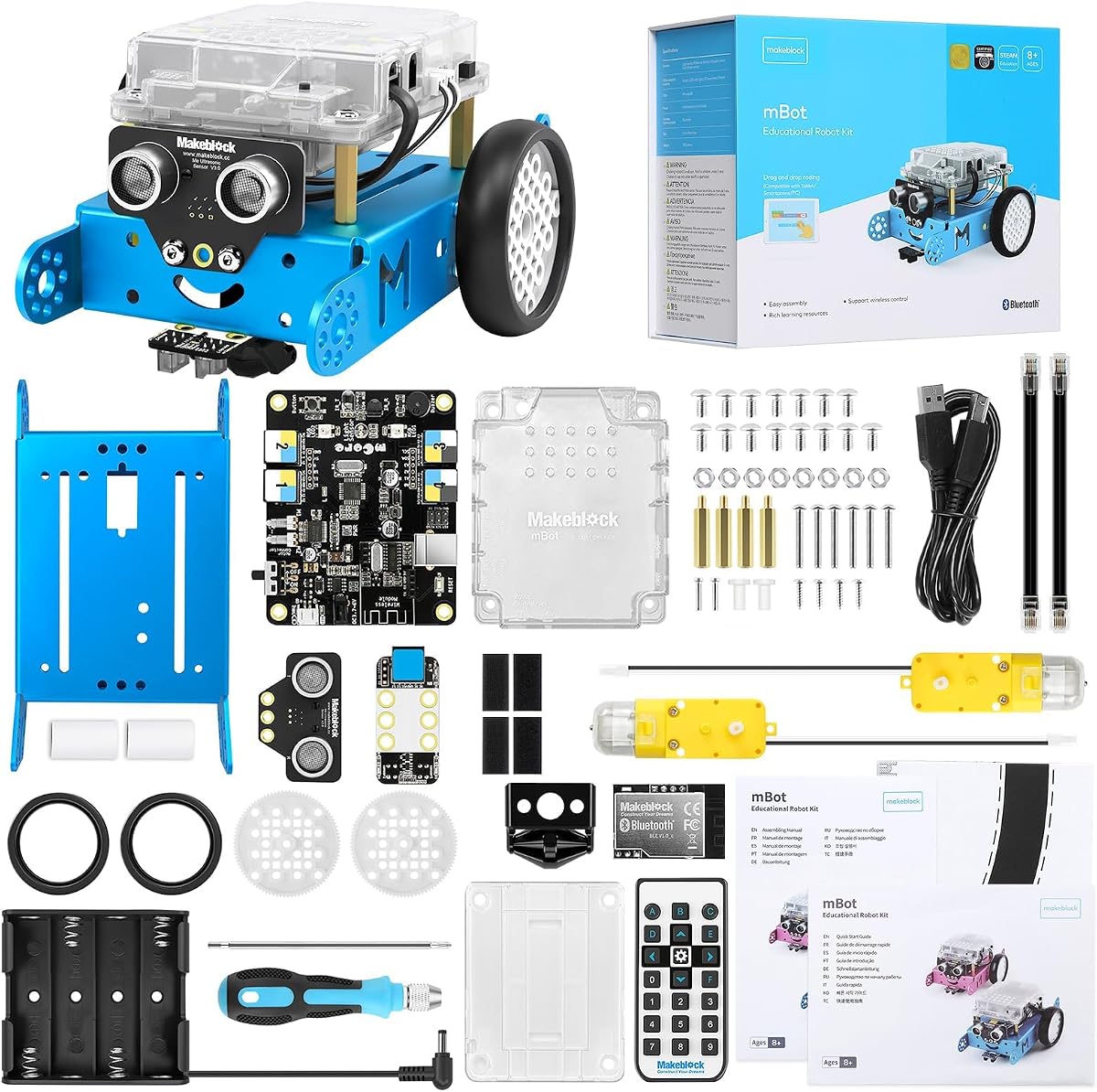
The Makeblock mBot is a highly-rated entry-level robot kit designed to introduce kids to electronics and programming. With a strong rating of 4.6, it is praised for its simplicity and educational value. The kit bridges the gap between play and learning by using intuitive software environments.
We may earn a commission when you buy through this link, at no additional cost to you.
Children can start with block-based coding using Scratch and gradually move to text-based Arduino IDE as they grow. The metal chassis ensures durability, while the clear instructions allow assembly in as little as fifteen minutes. Add-on packs offer even more flexibility for expanding projects later.
One downside is that the kit does not include the required batteries, which means extra purchases are necessary to start. The sensor suite is standard but might limit complex autonomous behaviors compared to higher-end kits. Still, for its price and educational focus, it remains a top choice for young learners.
This robot is perfect for parents or teachers looking to spark an interest in robotics without overwhelming students with complexity. The mBlock apps make it easy to control the robot remotely or play coding games, turning learning into an engaging and interactive activity.
Drag-and-drop coding blocks make programming concepts accessible to young users before transitioning to text-based languages.
The open-source system allows connection to hundreds of electronic modules and LEGO parts for extended creativity.
We may earn a commission when you buy through this link, at no additional cost to you.
The ELEGOO Conqueror is a robust robot tank kit that offers superior stability compared to wheeled alternatives. With a rating of 4.4, it appeals to users who want a more rugged build experience. The stainless steel chassis and tracks make it suitable for varied terrains and heavier payloads.
We may earn a commission when you buy through this link, at no additional cost to you.
Its adjustable servo-mounted camera allows you to change the viewing angle during operation, providing better inspection capabilities. The kit includes a comprehensive set of sensors including ultrasonic and line-tracking modules for diverse programming challenges. Assembly involves more steps but results in a sturdy and impressive final product.
While it is more expensive than some car kits, the metal construction and tank capabilities justify the cost for serious hobbyists. The assembly process is detailed and may take longer than simpler kits, but the learning experience is deeper. It supports both block coding and Arduino IDE for flexibility.
This kit is best suited for intermediate builders or STEM programs that need a durable platform for longer-term projects. Whether you are navigating mazes or setting up patrol routes, the Conqueror offers a versatile and engaging robotics experience.
The camera mount allows you to tilt the view during driving for better navigation and inspection of surroundings.
Switch between obstacle avoidance, line tracking, and auto follow to practice different coding strategies easily.
We may earn a commission when you buy through this link, at no additional cost to you.
The ELEGOO Tumbller is a fascinating kit that teaches the physics of motion and balance through a self-balancing robot. With a 4.5 rating, it is highly regarded for its engaging challenge and educational depth. Building a robot that stands on two wheels is a rewarding achievement for any maker.
We may earn a commission when you buy through this link, at no additional cost to you.
The kit includes motion sensing and real-time motor control to keep the robot upright while offering six fun ways to play. Users can switch between remote control, app control, and auto follow to explore different interactions. The tutorial guides you through the wiring and calibration needed for success.
Calibration can be tricky for beginners, and the robot may struggle on uneven surfaces without careful handling. However, the core experience of understanding feedback loops and control logic is invaluable. It is a compact project that fits well on a desk or classroom table.
Ideal for science fair projects or physics classes, this kit demonstrates complex engineering principles in a fun format. If you want to move beyond simple driving and explore how robots maintain stability, the Tumbller is an excellent choice.
The self-balancing mechanism provides a hands-on way to learn about stability and control systems.
Reserved I/O pins allow you to add extra sensors and expand the robot capabilities further.
We may earn a commission when you buy through this link, at no additional cost to you.
The ACEBOTT Smart Robot Car Kit stands out for its Mecanum wheels that allow movement in any direction. With a 4.2 rating, it offers advanced motion capabilities that most standard kits lack. This makes it ideal for users who want to experiment with complex path planning and navigation.
We may earn a commission when you buy through this link, at no additional cost to you.
The kit uses an advanced ESP32 controller which simplifies programming and connects well with the app or remote. Users can master 360-degree movement, including sideways sliding and rotation. The story-rich tutorials help beginners understand the hardware and software principles step by step.
Because of the special wheels, control logic is slightly more complex than standard differential drive robots. Also, the kit does not include batteries, so you will need to source them separately. Despite these minor hurdles, the flexibility and learning potential are significant.
This robot is perfect for teens or adults interested in AI navigation and advanced robotics. Whether you are following a path or navigating obstacles, the ACEBOTT provides a modern platform for learning state-of-the-art robotics concepts.
These wheels allow the robot to move forward, backward, left, right, and rotate on the spot.
You can add camera, robotic arm, or solar packs to expand the functionality beyond a simple car.
We may earn a commission when you buy through this link, at no additional cost to you.
The LAFVIN R3 Smart Robot Car offers impressive features at a budget-friendly price point. With a strong 4.5 rating, it proves you do not need to spend a lot to get a quality FPV experience. This kit is perfect for those who want to try robotic coding without a large investment.
We may earn a commission when you buy through this link, at no additional cost to you.
Its built-in ESP32-S3 module enables smooth Wi-Fi video streaming and control via mobile devices. The pan-tilt unit lets you adjust the camera angle for better inspection. The five intelligent operation modes provide a solid foundation for learning obstacle avoidance and line following.
While the build is mostly plastic and lacks the durability of metal kits, it is robust enough for indoor learning. The sensors are easy to connect, reducing the risk of wiring errors. It is a great starter kit that balances cost and functionality well.
If you are on a budget but still want a camera-enabled robot, this is an excellent choice. It supports open-source code, allowing you to dive into the community resources and customize the robot behavior freely.
Receive real-time video on your phone to see where the robot is going while controlling it remotely.
Free resources and tutorials allow you to understand the code deeply and modify it for your needs.
We may earn a commission when you buy through this link, at no additional cost to you.
The ACEBOTT 4 in 1 Smart Robot Arm kit provides the flexibility to build four distinct robot models from one set of parts. With a 3.9 rating, it is a complex but rewarding project for teens and adults. The modular design encourages creativity by allowing combinations like a tank with a robotic arm.
We may earn a commission when you buy through this link, at no additional cost to you.
The 5DOF programmable robotic arm adds a new dimension to interaction, allowing you to grab and place objects. You can also build a rugged tank chassis for outdoor use. The kit includes 16 story-based tutorials to guide you through the assembly and coding process.
Because the kit involves many parts, the assembly can take significant time and patience. The app controls are functional but may occasionally experience connection issues. Despite these challenges, the educational value of learning mechanical structures and coding is substantial.
This kit is best for families or classrooms that want to maximize the use of one investment. It offers a complete STEM experience from mechanical assembly to complex programming, making it a great gift for aspiring engineers.
Use the same base and parts to create a tank, a car, or a robot arm depending on your interest.
Learn how to program degrees of freedom to control complex movement and object manipulation.
We may earn a commission when you buy through this link, at no additional cost to you.
The SunFounder Ultimate Starter Kit is a comprehensive solution for those who want to learn broader electronics beyond robotics. With a 4.5 rating, it includes 192 items and 87 projects ranging from LEDs to IoT applications. It is designed to guide users through a progressive learning journey.
We may earn a commission when you buy through this link, at no additional cost to you.
Online video tutorials and community support help users navigate the vast number of components. You can build smart cars, basic circuits, and IoT devices, making it a versatile learning platform. The included Uno board and sensors are high quality and reliable.
The sheer volume of parts can be overwhelming for someone who just wants a quick robot project. However, for a long-term learning resource, the variety is unmatched. You will not run out of projects anytime soon with this kit.
Ideal for students who want to master both electronics and coding, this kit offers a deep dive. If you are committed to learning IoT and sensor integration alongside robotics, this is the most educational option available.
Expert-designed video courses teach you skills systematically from basic concepts to advanced topics.
Learn to connect your projects to the internet for smart home applications and remote monitoring.
We may earn a commission when you buy through this link, at no additional cost to you.
The Makeblock mBot Ultimate is a premium kit designed for aspiring engineers who want a professional build experience. With a 4.3 rating, it offers aluminum alloy parts and a powerful control board. It is suitable for older teens and adults who want to build robust, complex robots.
We may earn a commission when you buy through this link, at no additional cost to you.
You can build 10 unique models, including a functional robotic arm or a tank. The system supports both Arduino IDE and Raspberry Pi, allowing for advanced machine vision and AI projects. The MegaPi board drives multiple motors in perfect sync for precision.
The price is higher than other kits, but the durability and advanced features justify the cost for serious makers. The industrial-grade parts ensure the robot lasts longer under regular use. It requires six AA batteries which must be purchased separately.
This kit is ideal for advanced classrooms or hobbyists looking to transition to professional robotics. If you want to learn how to design and build industrial-quality robots at home, this is the most capable kit on the market.
High-strength aluminum parts make the robot durable and safe for advanced projects.
Connect a Pi to run Python code and add computer vision capabilities to your robot.
We may earn a commission when you buy through this link, at no additional cost to you.
The Freenove Hexapod Robot Kit offers a unique robotic experience with its six-legged design. With a 4.1 rating, it is a favorite for users who want to explore legged locomotion. Each leg has three motors controlled independently, allowing for complex walking and crawling motions.
We may earn a commission when you buy through this link, at no additional cost to you.
The kit provides detailed step-by-step assembly guides and prewritten code libraries to simplify programming. You can control it via remote, smartphone app, or computer. The flexibility to walk, crawl, or twist makes it a fun project for exploring kinematics.
Assembly is complex due to the number of servos and joints involved. Also, batteries are not included, so you will need to source them separately. Despite the complexity, the experience of building a walking robot is highly rewarding.
This kit is best for users interested in biology-inspired robotics and complex mechanics. If you want to see a robot mimic animal movement, this hexapod offers a fascinating and educational build experience.
Each motor is controlled independently allowing for complex gait patterns and movements.
Prewritten code examples help you understand how to control the legs and balance the robot.
We may earn a commission when you buy through this link, at no additional cost to you.
Choosing the right robot kit depends on your skill level, budget, and what you want to learn. This guide helps you compare key factors to find the perfect match.
Different kits are designed for different ages and coding experience. Beginners should look for kits with block coding options and simple assembly. Advanced users might prefer kits that support Arduino IDE or Python for deeper customization.
Choose a kit that challenges you just enough without causing frustration.
Most kits use Arduino-compatible boards like Uno or ESP32. Check if the kit includes the software needed and whether it supports visual or text-based coding. A versatile controller allows you to expand the robot's capabilities later.
Ensure the controller matches your preferred learning path for coding.
Sensors allow your robot to interact with the world. Look for kits with ultrasonic sensors for obstacle avoidance, line tracking sensors for paths, and cameras for FPV. More sensors mean more complex projects.
Select a kit with the specific sensors needed for your intended projects.
Materials matter for longevity. Metal chassis and parts are more durable than plastic. If you plan to take your robot outdoors or use it heavily, invest in a metal kit. This ensures your investment lasts longer.
Check material quality to ensure the robot withstands regular use.
Batteries are often sold separately. Some kits use rechargeable lithium batteries which are convenient. Others need standard AA batteries which are cheaper upfront but cost more over time. Check compatibility with common battery types.
Consider the power source to ensure convenience and cost effectiveness.
A strong community helps when you get stuck. Look for kits with active forums, tutorials, and open-source code. Good documentation and video courses make a big difference in your learning experience.
Choose a brand with good support and learning resources.
Some kits allow you to add arms, tanks, or cameras later. Modular kits grow with your skills. If you want to build multiple projects from one base, look for add-on packs and compatible parts.
Prioritize expandable kits for long-term learning value.
Prices vary from under $50 to over $300. Determine your budget and what features are most important. Higher priced kits often offer better materials and more features. Balance cost with educational return.
Find the best value for your specific needs and budget.
When you first receive your kit, organize all components and check against the parts list. Follow the assembly instructions step by step, ensuring wires are connected securely and screws are tightened properly. Take your time to understand how each part fits into the whole.
After assembly, install the software on your computer or mobile device. Download the sample code and upload it to the controller to test basic functions. Use the remote control or app to drive the robot around and verify all sensors are working correctly.
Maintain your robot by keeping it clean and storing it in a dry place. Check battery levels before use and recharge or replace them as needed. Periodically inspect moving parts for wear and tighten any loose screws to prevent malfunctions.
Most kits are designed for ages 8 and up with adult guidance for younger kids. Advanced kits are better suited for teens and adults. Always check the recommended age and skill level before purchasing to ensure the project matches the user.
Many beginner kits include block coding options that require no prior experience. You can start with visual blocks and progress to text code later. Tutorials are provided to teach coding step by step so beginners can learn as they build.
Most kits support Scratch for beginners and C++ via the Arduino IDE for advanced users. Some allow Python or other languages if connected to a Raspberry Pi. Check the documentation to see which languages are compatible.
Many kits do not include batteries to reduce cost and shipping weight. You will typically need to buy AA or rechargeable Li-ion batteries separately. Check the product details to know what type of power is required.
Yes, most kits are open-source and allow code modification. You can change parameters like speed and sensor sensitivity. This feature helps you learn deeper programming concepts and customize the robot behavior.
Most manufacturers provide video tutorials and community forums for help. You can also search online for specific assembly guides for your model. Do not hesitate to reach out to customer support if parts are missing or instructions are unclear.
We have reviewed ten of the best Arduino robot kits available today for a range of skill levels and interests. The ELEGOO UNO R3 stands out as the top pick for its balance of features and ease of use. For budget seekers, the LAFVIN offers great value, while the Makeblock mBot Ultimate is ideal for advanced builders.
When selecting a kit, prioritize factors like build quality, sensor availability, and coding support that align with your goals. Whether you want to teach a child or explore robotics yourself, these kits provide hands-on learning that inspires innovation. Choose the one that offers the right challenge for you.
Remember to check current prices and availability before purchasing as stock varies frequently. With these kits, you can bring your ideas to life and develop valuable STEM skills. Start building today and enjoy the journey of creating your own smart robot.