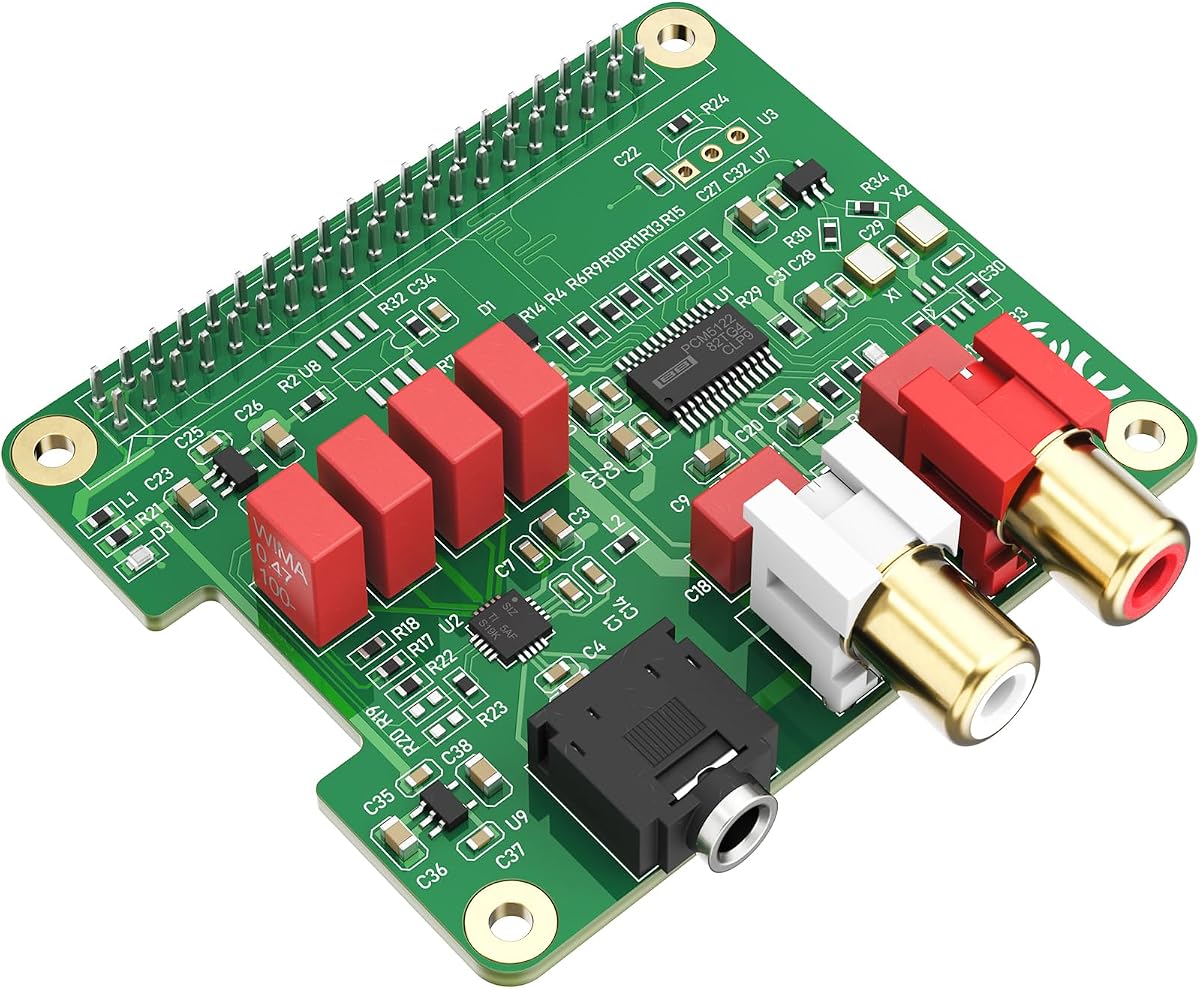
HiFi DAC HAT for Raspberry Pi 5/4/3B+/Zero
4.5Editor score
384kHz 32bit PCM5122 DAC
Dual oscillators reduce jitter
RCA and 3.5mm outputs
This guide compares the top DAC for Raspberry Pi models for audiophile sound quality high resolution support and ease of use with your single board computer
Finding the right DAC for Raspberry Pi can transform your media center into a high fidelity audio source. These expansion boards bypass the weak onboard audio to deliver crisp clear sound for music and movies.
We compared ten top rated models based on audio specs software compatibility and build quality. Our list covers budget friendly options and premium solutions with balanced outputs and digital interfaces.
Each pick highlights key features pros and cons to help you choose. Note that stock and pricing change often so check the current listing before you buy your next audio upgrade.
4.5Editor score

4.5Editor score

4.1Editor score
This table lets you see the key differences side by side. Review the sample rates chip types and output options to find the model that fits your Pi setup and speaker system.


This HiFi DAC HAT offers seamless integration with Pi 5 4 and Zero models. It scores high for ease of use and delivers clean audio without extra wiring or soldering.
We may earn a commission when you buy through this link, at no additional cost to you.
The PCM5122 chip with dual oscillators ensures low jitter and accurate playback. You get gold plated RCA outputs and a dedicated headphone amp for flexible listening options.
While it lacks balanced outputs it still provides 112dB SNR and wide software support for Volumio and Moode. The tradeoff is minimal for most casual and critical listeners.
Buy this if you want plug and play audio on a budget. It is the top pick for budget conscious users who value compatibility and clean sound.
The board fits the 40 pin header perfectly and includes onboard EEPROM for plug and play. This means you do not need drivers or manual config files.
Independent 45 and 49 MHz oscillators master the clock signal. This reduces timing errors and keeps audio stable across different sample rates.
We may earn a commission when you buy through this link, at no additional cost to you.
The DAC Mini Hat is designed to fit the Zero series without overhang while supporting all 40 pin Pis. It offers a great balance of size and sound quality.
We may earn a commission when you buy through this link, at no additional cost to you.
Equipped with PCM5122 and TPA6133 amp it delivers 2.1Vrms for clean driving of headphones. Gold plated outputs provide reliable analog connections.
Its value is unmatched for compact setups but it lacks digital or balanced outputs. This is acceptable if your system only needs analog RCA or 3.5mm.
Choose this if you have a Pi Zero and want strong sound in a tiny board. It is excellent for small music projects and portable audio rigs.
The layout avoids overhang on Zero 2 W and Zero 2W. This keeps your case clearance safe and prevents short circuits with metal enclosures.
The onboard amp drives higher impedance headphones better than raw line outs. This lets you enjoy music directly from the Pi without extra gear.
We may earn a commission when you buy through this link, at no additional cost to you.
This pro hat brings flagship ESS9038Q2M tech to Pi with balanced outputs and DSD512 support. It is the top pick for audiophiles seeking true reference quality.
We may earn a commission when you buy through this link, at no additional cost to you.
Dual oscillators and three op amps deliver 129dB DNR and crystal clear separation. The balanced X+ X outputs drive pro gear and sensitive headphones with authority.
The higher cost and larger footprint are tradeoffs for top performance. For most users it is more than enough but ensure your case supports the size.
Pick this if you need balanced analog out or play DSD files. It is the best choice for serious listening and home theater integrations.
Balanced outputs reduce noise over long cables. This is ideal for studio monitors or setups where the amp sits far from the Pi.
The ES9038Q2M chip is found in high end gear. It provides ultra low distortion and dynamic range that rivals standalone audio components.
We may earn a commission when you buy through this link, at no additional cost to you.
The Digi One Hat focuses on clean digital audio with galvanic isolation to eliminate noise from the Pi. It outputs S/PDIF over optical and coax.
We may earn a commission when you buy through this link, at no additional cost to you.
Low jitter external oscillators and a 150M isolator ensure bit perfect streams. This is perfect if you have a quality external DAC or amp.
Without analog out it is only for digital setups. The isolation is a standout feature that prevents ground loops and hum in sensitive systems.
Buy this if you need clean digital feed to an external DAC. It is a robust solution for audiophiles who want clean transport data.
The isolator separates the Pi power and digital signals from the board. This stops ground loop hum and improves signal quality significantly.
Both optical TOSLINK and electric RCA outputs support up to 192kHz. This gives flexibility for connecting to AV receivers or DACs.
We may earn a commission when you buy through this link, at no additional cost to you.
This module uses PCM5122 over I2S and includes LED indicators for easy status checks. It is a simple and reliable board for audio projects.
We may earn a commission when you buy through this link, at no additional cost to you.
Red and green LEDs show power and decode status. The board reserves GPIO26 for IR so you can add remote control to your player.
It is more basic than HATs with no dedicated amp. The SNR is solid but expect lower output than boards with extra circuitry.
Pick this for minimal setups or learning projects. It is a great low cost DAC for building your own player.
The onboard LEDs let you see if the DAC is powered or decoding. This helps you debug issues quickly without opening your case.
GPIO26 is reserved so you can connect an IR receiver. This enables remote control for volumio or xbmc setups out of the box.
We may earn a commission when you buy through this link, at no additional cost to you.
RASPIAUDIO Audio DAC Hat offers plug and play convenience via EEPROM for auto config. It supports a wide range of Pi models from Zero to 5.
We may earn a commission when you buy through this link, at no additional cost to you.
With 112dB SNR and 384kHz support it delivers clean analog audio. The colored PCB gives it a nice look for visible projects.
It is a solid choice for general use but lacks digital out. If you need balanced or digital you should look at more pro options.
Choose this for reliable everyday listening. It is a great drop in replacement for the onboard audio on any Pi.
The EEPROM chip lets the board work without extra driver installs. This saves time and avoids manual config steps on your OS.
112dB SNR and 384kHz support cover high res audio needs. This ensures music sounds clear and detailed even in quiet passages.
We may earn a commission when you buy through this link, at no additional cost to you.
This BLSTR DAC is designed for Pi 5 and includes a ground loop isolator to reduce noise. It offers plug and play audio through a 3.5mm jack.
We may earn a commission when you buy through this link, at no additional cost to you.
Texas Instruments PCM5122 powers the sound and the isolator prevents hum. This board is perfect if you see noise on your output lines.
It lacks RCA outputs which limits options for line level gear. The 3.5mm jack works well for headphones and most small speakers.
Buy this for Pi 5 setups needing noise reduction. It is a great choice for clean audio without extra external isolators.
The included isolator stops unwanted hum from ground loops. This is vital in setups with multiple devices sharing a power source.
Designed specifically for Pi 5 the board matches the power and GPIO needs. This ensures stable operation with the latest Pi models.
We may earn a commission when you buy through this link, at no additional cost to you.
This DSP board has a 300MHz core that can process audio with room eq. It is for advanced users who need digital mixing and conversion.
We may earn a commission when you buy through this link, at no additional cost to you.
Asynchronous sample rate converter can up or down mix sources. You can also run it standalone with EEPROM boot without a Pi attached.
The price and case constraints make it a niche pick. You must use the Universal enclosure so factor that into your build plan.
Pick this if you need audio processing or room correction. It is the best DSP DAC for complex multi speaker home audio.
The onboard DSP handles complex tasks like upsampling and mixing. This lets you tweak DSP settings on the fly without a PC.
Inputs support up to 96kHz and outputs to 192kHz. You can connect digital sources directly and process them internally.
We may earn a commission when you buy through this link, at no additional cost to you.
HiFiBerry Digi+ Standard provides a dedicated S/PDIF chip for digital out. It supports 192kHz 24bit and delivers bit perfect audio streams.
We may earn a commission when you buy through this link, at no additional cost to you.
Both optical and electrical connectors give you flexibility for your amp. The chip does not modify data so your source stays intact.
It is a pure transport board with no analog. If your setup is all digital this is a very stable and reliable option.
Choose this for digital out in older Pi builds. It is a classic choice for reliable streaming to external DACs.
The data stream is not modified so you get exact audio. This matters for high fidelity setups where bit level accuracy is key.
Both Toslink and coax connectors support up to 192kHz. This ensures you can connect to many common DACs and receivers.
We may earn a commission when you buy through this link, at no additional cost to you.
This module is a very affordable DAC using PCM5102A for I2S audio. It offers better sound than the Pi onboard output for low cost.
We may earn a commission when you buy through this link, at no additional cost to you.
The stereo jack is soldered which saves time on your build. It is a good option for voice projects or simple audio players.
It lacks many extra features but delivers clean digital to analog conversion. It is more basic than HATs but works well for prototypes.
Buy this for tight budgets or hobby projects. It is a great entry DAC to upgrade Pi sound cheaply.
The stereo jack comes pre soldered so you can skip soldering wires. This reduces build time and complexity for quick prototypes.
The PCM5102A offers solid 32bit support and low noise. For its price it sounds much better than the onboard Pi audio.
We may earn a commission when you buy through this link, at no additional cost to you.
Choosing a DAC for Raspberry Pi depends on your audio goals and hardware setup. This guide covers the key factors to consider when buying.
The DAC chip determines baseline quality. Common chips like PCM5122 offer great value while flagship ESS chips give higher fidelity.
Look for 32bit 384kHz support for modern high res audio.
Higher rates like 384kHz and 32bit cover high res files. Ensure your music player supports the format you plan to use.
Match your DAC limits to your library needs for best results.
Analog outputs like RCA and 3.5mm are standard for speakers. Balanced XLR or X+ X are better for professional gear and long runs.
Choose outputs that match your amp or speakers.
Some boards offer S/PDIF or I2S for digital only paths. This helps if you have an external DAC or need to feed a receiver.
Digital paths avoid onboard noise and simplify your chain.
Dual oscillators or master clock modes reduce jitter and improve clarity. Boards with external clocks outperform designs that rely on the Pi clock.
This ensures stable audio especially during high rate playback.
Check if the DAC works with Volumio Moode or LibreELEC. HATs often include EEPROM for plug and play without manual driver installs.
Good support saves you hours of setup time and config work.
Boards vary in height and width. Ensure your case has enough clearance for the HAT to fit without shorting out or overheating.
Compact boards are best for Zero and mini setups.
Some boards include an onboard amp for headphones. This delivers more power and lower impedance than a standard line output.
Use this if you listen with cans instead of speakers.
Install the board by aligning it over the GPIO pins and securing with spacers. Ensure no pins touch metal to avoid shorts.
Configure your OS to use the DAC by selecting the HAT in audio settings or adding driver files. Most HATs auto detect on boot.
Maintain your setup by keeping vents clear and avoiding moisture. Clean ports with a dry brush and check wiring regularly.
No most boards plug into the GPIO header without soldering. Some modules may require minor wiring but HATs are designed for tool free install.
The HiFi DAC Pro Hat with ES9038Q2M and DSD support is best for high res. It offers balanced outputs and flagship chip quality.
Check your case height and width before buying. Compact boards like the DAC Mini Hat fit Zero cases while others need standard enclosures.
Most HATs include EEPROM for plug and play on Linux based OS. Some boards may require simple config files but are generally driverless.
Yes most boards support Pi 5 including the BLSTR DAC and HiFi DAC HAT. Verify compatibility on the product page before buying.
S/PDIF is a digital output for external DACs and receivers. I2S is a digital bus used between the Pi and onboard DAC boards.
Yes boards with I2S and simple layouts work for voice. Modules like the HiLetgo PCM5102 are good for low cost audio playback.
Use boards with galvanic isolation or built in ground loop isolators. Ensure proper grounding and avoid running power and audio cables together.
Our top picks include the HiFi DAC HAT for budget users the HiFi DAC Pro Hat for premium quality and the HiFiBerry DAC+ DSP for advanced processing.
Choose a board based on output needs chip quality and case size. Balanced outputs and low jitter clocks deliver the best audio performance.
Always check current stock and price before buying. Deals change often so verify details on the Amazon page before placing your order.