
Mikrotik – CRS520-4XS-16XQ-RM 28 2.5Gb 4 SFP28 25Gb 16 WSFP28 100Gb Switch
4.6Editor score
28 Gigabit SFP28 ports
100 Gigabit QSFP28 ports
Powerful quad-core ARM CPU
This guide compares the top 25GbE Switches with SFP28 Ports for 2026, evaluating performance, features, and reliability for data center needs.
Modern data centers require robust networking solutions to handle increasing bandwidth demands. 25GbE Switches with SFP28 Ports offer the perfect balance of speed and efficiency for enterprise environments needing high throughput without excessive costs.
We evaluated ten leading switches based on port configurations, switching capacity, management features, and overall reliability. Our analysis focuses on models that deliver genuine 25Gbps connectivity alongside flexible uplink options for diverse network architectures.
Each pick highlights specific strengths like low latency, advanced routing, or cost-effective multi-gigabit support. Prices and availability fluctuate frequently, so verify current details before purchasing to ensure you get the best value for your infrastructure needs.
4.6Editor score

5.0Editor score

The following table provides a side-by-side comparison of all ten switches, highlighting key specifications such as port counts, switching capacity, and unique features to help you decide quickly.






The QNAP QSW-M7230-2X4F24T-US is engineered for environments demanding ultra-high-speed connectivity. Its design focuses on delivering non-blocking throughput through a mix of 100G, 25G, and 10G ports, making it a powerful choice for modern data centers.
We may earn a commission when you buy through this link, at no additional cost to you.
Its standout quality lies in its ability to handle lossless network performance. By integrating Priority Flow Control and Explicit Congestion Notification, this switch minimizes packet loss, which is critical for RoCEv2 and high-speed data transmission tasks like AI training.
While powerful, the switch offers robust Layer 3 Lite features including static routing and QoS. This ensures efficient network segmentation and secure data routing without requiring enterprise-grade complexity. It bridges modern optical backbones with existing copper setups effectively.
Buyers looking for a switch to support intensive virtualization and large-scale NAS deployments should consider this model. It provides the flexibility needed for growing businesses needing seamless integration between different speeds and media types.
The inclusion of Lossless Network Performance technologies ensures minimal latency and packet loss, crucial for compute-heavy tasks like machine learning clusters and big data processing.
Advanced features like IPv4/IPv6 static routing and VLAN support allow for sophisticated network segmentation without the overhead of a full routing protocol suite.
We may earn a commission when you buy through this link, at no additional cost to you.
The TRENDnet TEG-S50284 offers a robust solution for networks needing multi-gigabit speeds without jumping to full 25G infrastructure. It provides 24 ports capable of 2.5G speeds over existing cabling, which is an excellent value for many SMBs.
We may earn a commission when you buy through this link, at no additional cost to you.
Its key strengths include compliance with NDAA and TAA standards, making it suitable for government customers. The lifetime manufacturer protection adds significant value, ensuring long-term reliability and support from a trusted networking vendor.
While it lacks native 25G SFP28 ports, the four 10G SFP+ uplinks provide a solid backbone for aggregation. The smart fans ensure energy efficiency by adjusting speed based on cooling needs, which keeps operating costs low.
This switch is ideal for businesses wanting to upgrade access speeds incrementally. It balances performance and cost effectively, offering reliable tech support and a straightforward setup for those not requiring advanced routing capabilities.
Compliance with NDAA and TAA standards ensures this switch meets strict regulatory requirements for government and security-conscious organizations in the US and Canada.
The lifetime manufacturer protection provides peace of mind, ensuring that the hardware remains supported for the duration of its operational life without additional warranty costs.
We may earn a commission when you buy through this link, at no additional cost to you.
The Cisco Nexus N9K-C92160YC-X represents high-density connectivity with 48 ports supporting 25GbE SFP28. As a renewed product, it offers access to enterprise-grade hardware at a more accessible price point while maintaining essential functionality.
We may earn a commission when you buy through this link, at no additional cost to you.
Its key strengths include dual AC power options and a robust chassis designed for demanding server rooms. The professional inspection and testing by vendors aim to ensure that the device meets strict quality standards before reaching the buyer.
Buyers should consider the trade-off between cost savings and the inherent risks of pre-owned equipment. However, the ability to get 25Gbps connectivity across 48 ports for a lower price is a compelling argument for budget-conscious data centers.
This switch is best for organizations needing massive port counts for server aggregation. It delivers the reliability expected from Cisco hardware, making it a strong choice for those looking to expand capacity without buying brand-new flagship models.
With 48 25GbE ports, this switch supports dense server racks, allowing for massive bandwidth aggregation essential for virtualized environments and storage networks.
The professional inspection process ensures that the renewed unit functions correctly, offering a balance between cost efficiency and performance reliability for critical infrastructure.
We may earn a commission when you buy through this link, at no additional cost to you.
The Mikrotik CRS520-4XS-16XQ-RM is an ultra-fast enterprise switch designed for demanding network environments. It combines 28 SFP28 ports with robust processing power, making it suitable for high-bandwidth requirements like large-scale data centers.
We may earn a commission when you buy through this link, at no additional cost to you.
Its standout quality is the powerful quad-core ARM CPU running at 2 GHz, supported by 4 GB of DDR4 RAM. This ensures that advanced routing and switching features do not compromise throughput, maintaining low latency even under heavy loads.
While it offers high performance, the premium price reflects its robust specifications. However, for networks requiring 100 Gigabit uplinks alongside 25G access ports, this switch provides a comprehensive solution that justifies the investment.
Buyers seeking a high-end switch with massive port counts and advanced processing should choose this model. It delivers the reliability and speed needed for professional environments needing precise control over data flows and network segmentation.
The quad-core CPU ensures that complex routing tasks and high-speed switching occur simultaneously without bottlenecks, essential for environments with heavy traffic patterns.
With 28 SFP28 ports and 100G uplinks, this switch scales effortlessly to meet growing bandwidth demands, making it ideal for expanding enterprise networks.
We may earn a commission when you buy through this link, at no additional cost to you.
The Ubiquiti UniFi Aggregation Switch Pro provides excellent value for networks needing 25G aggregation alongside standard 10G ports. It offers a unique 1.3 touchscreen that simplifies management significantly for those using the UniFi ecosystem.
We may earn a commission when you buy through this link, at no additional cost to you.
Key strengths include its Layer 3 switching capabilities and 760 Gbps switching capacity. This ensures it can handle high-bandwidth aggregation links efficiently. The integrated management via the UniFi Network application allows for remote monitoring and configuration.
Buyers should note that mixed speeds on SFP28 ports are limited when one port is set to 25Gbps. This trade-off is acceptable for most aggregation tasks where uniform high-speed links are preferred. The power supply failure protection adds reliability.
This switch is best for professionals already invested in the UniFi platform. It offers enterprise-grade features in a sleek package, making it a budget-friendly premium choice for modern offices requiring high-speed fiber uplinks and robust management.
Management via the UniFi Network web application allows administrators to control the switch alongside other network devices, creating a cohesive and easily manageable infrastructure.
The built-in color touchscreen provides immediate visibility of system health and connections, reducing the need for constant remote dashboard checks during routine maintenance.
We may earn a commission when you buy through this link, at no additional cost to you.
The Dell EMC PowerSwitch N3224P-ON stands out by combining PoE++ support with high-speed 25Gb and 100Gb ports. This makes it an ideal choice for environments requiring both powerful device connectivity and high-speed uplinks.
We may earn a commission when you buy through this link, at no additional cost to you.
Its key strengths include support for 25 Gigabit SFP28 and 100 Gigabit QSFP28 ports. This ensures future-proofing for data centers needing massive bandwidth. The manageable Layer 3 features allow for sophisticated network segmentation and routing control.
While the power consumption is high, the ability to deliver high-power PoE to endpoints like cameras and access points reduces the need for external injectors. The modular design supports upgrades and maintenance flexibility in demanding server rooms.
Buyers looking for a switch that balances power delivery with high-speed aggregation should consider this model. It is particularly suited for security and IoT deployments that require robust power management alongside fast data transmission capabilities.
PoE++ support allows for powering high-demand devices directly through the network, simplifying infrastructure and reducing the need for separate power sources at each endpoint.
The modular design ensures that the switch can adapt to changing network requirements, supporting upgrades and maintenance without replacing the entire unit.
We may earn a commission when you buy through this link, at no additional cost to you.
The TRENDnet TEG-3284WS is a web smart switch designed for ease of deployment. It offers 24 2.5G ports and 4 10G SFP+ uplinks, providing a cost-effective solution for networks needing multi-gigabit speeds.
We may earn a commission when you buy through this link, at no additional cost to you.
Its key strengths include Hive Enabled Cloud Service, allowing remote management via a web interface. The easy-to-use GUI reduces configuration complexity, making it suitable for IT teams needing quick setup without deep CLI knowledge.
Buyers should note that the cloud service may require an additional fee for full features. While the lifetime protection adds value, the switch lacks the advanced Layer 3 routing found in higher-end models, which may limit scalability.
This switch is ideal for small to medium businesses needing straightforward smart features. It balances cost and performance effectively, offering reliable support and compliance with regulatory standards for government-related projects.
Remote management capabilities simplify network oversight, allowing administrators to configure and diagnose the switch from anywhere, reducing on-site maintenance needs.
The web-based GUI provides an intuitive dashboard for monitoring traffic and configuring settings, reducing the learning curve for new administrators.
We may earn a commission when you buy through this link, at no additional cost to you.
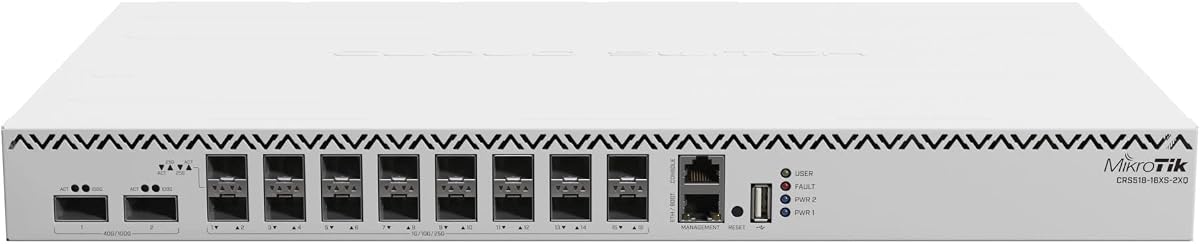
The MikroTik CRS518-16XS-2XQ-RM is a compact switch offering 16 25GbE ports and 2 QSFP28 uplinks. It provides excellent value for those needing high-speed connectivity in a small form factor without excessive power usage.
We may earn a commission when you buy through this link, at no additional cost to you.
Its key strengths include the RouterOS operating system which offers extensive flexibility for routing and firewall features. This allows advanced users to customize the switch behavior deeply, making it a favorite among network engineers.
While powerful, the learning curve is steep for those new to MikroTik environments. The limited memory may restrict complex feature sets compared to newer high-end models, but for standard switching, it remains robust.
Buyers needing a flexible, open-source friendly switch should consider this model. It delivers performance comparable to much more expensive options, making it ideal for custom infrastructure projects and smaller data centers.
The open-source RouterOS allows for deep customization of routing and security policies, appealing to network engineers who need granular control over their infrastructure.
The compact chassis saves rack space while delivering substantial bandwidth, making it perfect for edge computing or small office environments requiring high-speed fiber.
We may earn a commission when you buy through this link, at no additional cost to you.
The Cisco N9K-C93180YC-EX offers unmatched connectivity with 48 fixed 25-Gbps SFP+ ports and 6 fixed 100-Gbps QSFP28 ports. As a renewed unit, it brings enterprise-grade performance to those seeking value without sacrificing reliability.
We may earn a commission when you buy through this link, at no additional cost to you.
Its key strengths include cut-through switching architecture providing latency of less than 1 microsecond. This ensures smooth operations for big data processing. Support for VXLAN and ACI further simplifies network virtualization and automation for complex deployments.
Buyers should consider the benefits of hot-swappable power supplies and fans which ensure high availability. While it is a renewed unit, the quality assurance processes make it a viable option for businesses looking to modernize their infrastructure cost-effectively.
This switch is best for large-scale data center deployments needing high bandwidth and flexibility. It offers a robust platform for virtualization and future expansion, making it an excellent choice for enterprises demanding consistent performance.
The low-latency cut-through switching ensures that packets are forwarded immediately, reducing delays that can bottleneck high-performance computing and real-time applications.
Support for VXLAN and ACI allows for scalable and highly available network virtualization, essential for modern cloud environments and dynamic workload management.
We may earn a commission when you buy through this link, at no additional cost to you.
The D-Link DGS-1210-28 offers a reliable budget-friendly option for smart managed switching. With 24 Gigabit ports and 4 SFP combo ports, it supports high-speed uplinks while maintaining a quiet, fanless design suitable for office environments.
We may earn a commission when you buy through this link, at no additional cost to you.
Its key strengths include NDAA compliance and a lifetime warranty ensuring long-term reliability. The surveillance mode with ONVIF support makes it ideal for IP camera networks, streamlining the deployment and optimization of video traffic.
Buyers should note that this model does not support 25GbE ports. However, its comprehensive security features like 802.1X and VLAN support provide robust protection for networks prioritizing data integrity over raw speed upgrades.
This switch is ideal for small businesses needing silent operation and reliable security features. It delivers strong value with easy web management, making it a safe choice for expanding networks where noise and power efficiency are priorities.
The fanless design ensures silent running, making this switch perfect for noise-sensitive environments like offices or classrooms without compromising cooling efficiency.
NDAA compliance ensures that the switch meets strict regulatory standards, making it suitable for government projects or high-security enterprise needs.
We may earn a commission when you buy through this link, at no additional cost to you.
Selecting the right switch involves evaluating port configurations, management capabilities, and specific use cases like AI workloads or general office networking.
Evaluate how many 25GbE SFP28 ports you need versus 10G or 100G uplinks. Ensure the switch supports the physical media you intend to use such as fiber or copper transceivers.
Focus on total port counts and speed mix to ensure your current and future devices connect efficiently without bottlenecks.
Check the total switching capacity in Gbps. A switch with high capacity ensures that all ports can operate at full speed simultaneously without traffic congestion.
Higher capacity switches are essential for environments with heavy data transfer loads like video production or big data processing.
Decide between managed, unmanaged, or smart managed options. Managed switches offer VLANs, QoS, and routing features which are critical for network security and traffic optimization.
Select a management interface that matches your team expertise such as CLI, Web GUI, or central controllers like UniFi Network.
Layer 3 switches provide routing capabilities allowing different subnets to communicate directly. This is vital for large organizations needing efficient traffic routing between departments.
For smaller networks Layer 2 or Layer 2+ switches may suffice unless you need complex inter-subnet routing capabilities.
Consider the form factor such as rackmountable or fanless. Fanless switches are ideal for quiet office spaces while high-power models may require robust cooling systems.
Ensure the switch fits your physical space and can operate reliably within your room's temperature and noise constraints.
Check for NDAA or TAA compliance if you are in government or high-security sectors. These standards ensure the hardware meets strict security and sourcing regulations.
Compliance is often a mandatory requirement for public sector projects and ensures the supply chain integrity of your infrastructure.
Look for Energy Efficient Ethernet features to reduce power consumption. If you need to power cameras or phones check for PoE or PoE++ support on the ports.
Balancing power usage with port requirements ensures cost-effective operations and reduces the need for external power injectors.
Review the warranty terms such as lifetime protection versus limited years. Reliable technical support ensures that you can resolve issues quickly without extended downtime.
Prioritize vendors with strong support reputations to maintain continuous network availability and access to firmware updates.
Start by updating the firmware to the latest version using the vendor's utility tool to ensure security patches and performance enhancements are applied.
Configure VLANs and IP settings using the web GUI or CLI to segment traffic and secure your network before connecting critical devices.
Monitor temperatures and fan speeds regularly via the dashboard to prevent overheating. Clean air vents periodically to maintain optimal cooling in high-density environments.
SFP28 ports support data rates up to 25Gbps while SFP+ ports typically support up to 10Gbps. SFP28 is designed for higher bandwidth applications like modern data centers. SFP+ transceivers can physically fit into SFP28 slots but usually operate at 10G speed.
No, 25GbE usually requires fiber optic transceivers like SFP28 modules. Copper options like NBASE-T exist but often use specialized cabling. Check the switch port specifications to ensure compatibility with your existing wiring infrastructure before purchasing.
Yes most 25GbE SFP28 ports are backward compatible with 10G SFP+ modules. The link will operate at 10Gbps instead of 25Gbps which allows for flexible upgradability. Verify the switch manual for specific speed negotiation details.
Layer 3 switches allow for routing between different subnets directly on the switch. This reduces latency and improves performance for large networks. It simplifies management by centralizing routing and switching functions in one device.
Latency depends on switching architecture such as cut-through versus store-and-forward. Cut-through switches provide lower latency by forwarding packets immediately. Quality of service settings and port density also impact overall network response times.
They can be overkill for typical home use unless you have massive local file transfers. However they offer future-proofing and support for high-end workstations. For most users standard 10G switches may be more cost-effective.
We reviewed ten powerful switches ranging from compact budget models to enterprise-grade powerhouses. The Mikrotik CRS520-4XS-16XQ-RM stands out as a premium choice for high bandwidth needs while the Cisco N9K-C93180YC-EX offers unmatched reliability.
Prioritize switches that align with your specific workload such as AI clustering or simple office aggregation. Ensure the port configuration matches your current transceivers to avoid unnecessary extra costs during deployment.
Prices and availability change frequently so check current listings before purchasing. Verify warranty terms and compatibility with existing cables to ensure a smooth integration into your network infrastructure today.